Vietnamese robusta and the EUDR: what importers need
A coffee importer in Antwerp signs for two containers of S16 wet polished robusta in October 2026. The beans will be picked in the Central Highlands in November and December, shipped from Ho Chi Minh City in early January and released through Belgian customs at the end of that month. Her customs broker sends one question before the vessel sails: "What is the reference number of your due diligence statement?" She has none yet. She had assumed the deforestation rules would slip a third time.
Regulation (EU) 2023/1115, the EU deforestation regulation or EUDR, applies to large and medium operators from 30 December 2026, and the Commission confirmed in May 2026 that there will be no further delay. From that date, green coffee placed on the EU market has to be deforestation-free, produced legally in the country of production and covered by a due diligence statement. The EU importer files that statement. The Vietnamese seller cannot file it for her, but it has to give her the data she needs, starting with the coordinates of every plot the coffee came from. This guide sets out the dates, the duties on each side and the file to ask for before loading.
The dates, after two postponements
The EUDR entered into force in June 2023 and was first meant to apply on 30 December 2024. Regulation (EU) 2024/3234 moved that to 30 December 2025. Regulation (EU) 2025/2650, published in December 2025, moved it again to 30 December 2026 and simplified the duties further down the supply chain. In its review package of 4 May 2026 the Commission updated its guidance and FAQ and kept the dates.
| Who or what | Date |
|---|---|
| Cut-off date: no deforestation or forest degradation on the plot after | 31 December 2020 |
| Large and medium operators, all downstream operators and traders | 30 December 2026 |
| Micro and small enterprises (outside the timber sector) | 30 June 2027 |
| Soluble coffee (HS 2101 11), newly added by a 2026 delegated act | 30 December 2027 |
Green coffee falls under HS 0901, which has been in Annex I of the regulation since 2023. Our robusta is declared under 0901.11 (not roasted, not decaffeinated), and roasted coffee under the same heading is covered too.
What counts is when the coffee is placed on the EU market, which for imports means the moment customs releases it for free circulation. The contract date and the loading date do not decide it. A lot bought in October 2026 and cleared in January 2027 falls under the rules. The dates have changed twice already, so check the Commission's EUDR page when you sign for a shipment that arrives near a deadline.
Who carries which duty
The regulation hands out duties by role in the supply chain, starting with whoever first puts the goods on the EU market.
- The operator is the company that first places the coffee on the EU market. For coffee bought FOB Vietnam, that is normally the EU importer named on the customs declaration. The operator runs due diligence, submits the due diligence statement in the EU Information System and quotes its reference number at customs.
- A downstream operator is, for example, a roaster that buys the same coffee from the importer inside the EU. Since Regulation (EU) 2025/2650, a downstream operator does not file its own statement. It collects and keeps the reference number from its supplier.
- A trader sells the coffee on inside the EU without processing it. Non-SME traders and downstream operators register in the Information System. Everyone keeps records of suppliers and customers for five years.
- The seller in Vietnam is outside the EU and has no account in the EU Information System. It still holds most of the evidence, so in practice the importer's due diligence is only as good as the seller's file.
On our orders the factory is the seller named on the contract and the invoice, and the buyer pays the factory directly. Luason is the factory's authorised sales agent. The traceability file for an EUDR lot therefore comes from the factory, and the contract says what it contains.
What low risk means for Vietnamese coffee
Under the country benchmarking in Commission Implementing Regulation (EU) 2025/1093 of May 2025, Viet Nam is classed as a low-risk country. Only four countries are high risk (Belarus, Myanmar, North Korea and Russia), and around fifty, Brazil and Indonesia among them, are standard risk.
Low risk removes part of the work. An operator sourcing coffee only from low-risk countries follows simplified due diligence under Article 13. It still collects all the information listed in Article 9, geolocation included, and still files the statement. It skips the formal risk assessment and risk mitigation, unless it learns something that points to a risk of non-compliance or circumvention. Competent authorities also check fewer operators: 1% for low-risk origins, against 3% for standard risk and 9% for high risk.
The simplified route holds only while the lot stays Vietnamese. A blend that adds coffee from a standard-risk origin needs full due diligence for that part. The Commission is due to review the benchmarking, so check the country list again before each season.
The file an importer needs from the seller
Article 9 lists what the operator must hold. Each line comes from somewhere in Vietnam.
| Article 9 information | Typical source in Vietnam | What to check |
|---|---|---|
| Product description and HS code | Contract and commercial invoice | 0901.11, grade and screen as contracted |
| Quantity in net kg | Packing list, weight certificate | Matches the bags loaded |
| Country of production | Certificate of origin | Viet Nam, no other origin mixed in |
| Geolocation of every plot | Collector, cooperative or farm mapping | One point or polygon per plot, see below |
| Date or time range of production | Harvest records | The crop year of the lot |
| Supplier and buyer names and addresses | Contract | Same legal entities as on the invoice |
| Evidence the plots were not deforested after 31 December 2020 | Satellite check against the coordinates | Report or screenshot per plot or per cluster |
| Evidence of legal production | Land use rights, permits, local rules on labour, tax and environment | Copies or a summary the importer can verify |
The legality line reaches beyond the land title. The EUDR asks for compliance with the laws of the country of production that apply to the plot: land use rights, environmental protection, labour rights, human rights, tax, anti-corruption and trade and customs rules. For a Vietnamese smallholder that usually starts with the land use right certificate for the plot.
Geolocation, plot by plot
The regulation defines geolocation as latitude and longitude with at least six decimal digits. A single point is enough for a plot of up to four hectares. A plot larger than four hectares needs a polygon, the points that trace its border. The usual format for the Information System is a GeoJSON file.
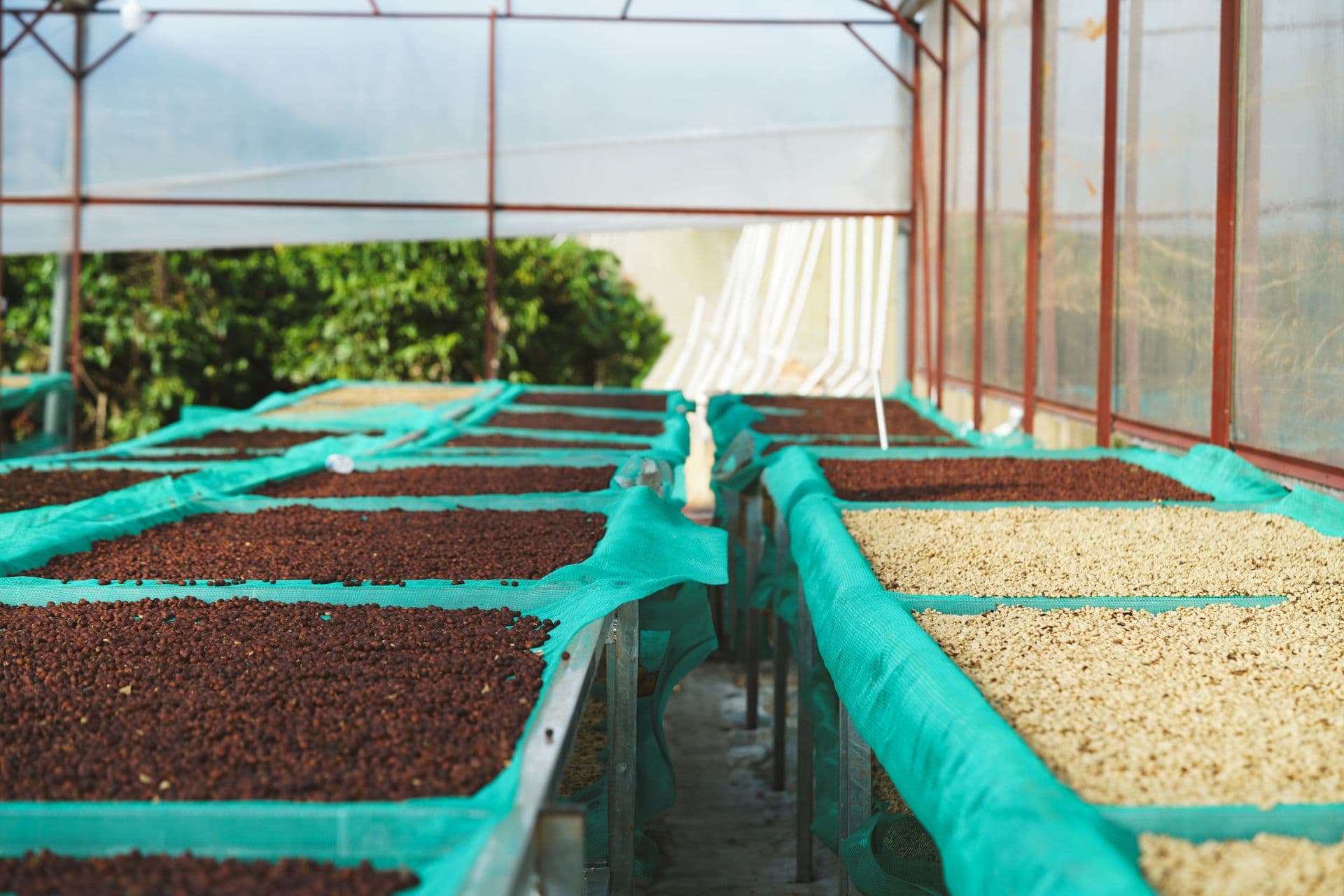
Most Vietnamese robusta comes from smallholder farms. One container of green coffee can therefore hold beans from dozens or hundreds of plots, collected through agents and cooperatives before it reaches the export plant. Every one of those plots has to be in the file. The Vietnam Coffee and Cocoa Association (Vicofa) estimated in August 2026 that 35% to 40% of current supply could already meet EUDR requirements, with the rest still being mapped. Exporters that sell EUDR lots keep that coffee separate from the point of purchase so it does not mix with unmapped beans in the warehouse.
Illustration
Check the geolocation file yourself
You do not need GIS software to catch the common errors. With the file from the seller:
- Open it in a free viewer such as geojson.io and look at the map. The points should sit on farmland in the provinces named in the file, not in a town centre, a lake or the sea.
- Count the decimals. Coordinates with four decimals are only accurate to about 10 metres and do not meet the six-digit rule.
- Look for polygons wherever the file gives a plot area above four hectares.
- Search for duplicates. The same point repeated for many farmers often means a collection point was mapped instead of the plots.
- Lay a few plots over a public forest map, for example Global Forest Watch or the EU Observatory on deforestation, and look for tree cover loss after 2020.
- Compare the total. The plots and the harvest period should plausibly produce the quantity on the packing list.
If something looks wrong, ask before the coffee is loaded. Once the lot is on the water, a missing plot can stop it at EU customs.
Our robusta and an EUDR lot
Our catalog has three green robusta grades: S18, S16 and S13, in wet polished or standard preparation and packed in 60 kg jute bags. The robusta coffee page has the moisture, black and broken and foreign matter limits for each grade, and the guide to robusta screen sizes explains what the screen numbers mean. Quality and EUDR are separate questions: an S18 lot can be perfect in the cup and still be refused at customs without its file.
For a lot that clears EU customs on or after 30 December 2026, write the EUDR terms into the contract:
- The lot is EUDR-compliant and of Vietnamese origin only.
- The seller delivers the geolocation file and the legality evidence before loading, in a format the buyer names (GeoJSON, for example).
- The harvest period is stated.
- The seller answers follow-up questions from the buyer or the competent authority for five years.
Requirements differ between buyers, so these terms are agreed per order. Tell us in your quote request that the coffee is for the EU market and when you expect it to clear customs, and we will confirm the traceability file the factory supplies for that lot. For a question before you quote, contact us.
Frequently asked questions
Does the EUDR apply to robusta shipped before 30 December 2026?
It depends on the customs date, not the shipping date. Coffee released for free circulation in the EU on or after 30 December 2026 by a large or medium operator must be covered by a due diligence statement, even if it left Vietnam earlier.
Does the Vietnamese exporter file the due diligence statement?
No. The operator that first places the coffee on the EU market, normally the EU importer, files the statement in the EU Information System. The exporter provides the geolocation and the evidence the importer needs.
Is Vietnamese coffee low risk under the EUDR?
Yes. Commission Implementing Regulation (EU) 2025/1093 classes Viet Nam as low risk. Operators follow simplified due diligence: they still collect geolocation and file the statement, but they do not need a formal risk assessment unless they learn of a risk.
Is roasted or instant coffee covered by the EUDR?
Roasted coffee is covered under HS 0901 from the same dates as green coffee. Soluble coffee under HS 2101 11 was added by a 2026 delegated act and is covered from 30 December 2027.
What changes for a small importer?
Micro and small enterprises outside the timber sector apply the rules from 30 June 2027. A roaster that buys from an EU importer is a downstream operator and keeps the importer's reference number instead of filing its own statement.
Sources
- Regulation (EU) 2023/1115 on deforestation-free products, Articles 2, 3, 9, 13 and 16, Annex I
- Regulation (EU) 2024/3234, first postponement to 30 December 2025
- Regulation (EU) 2025/2650, postponement to 30 December 2026 and 30 June 2027, downstream operators and traders
- European Commission, Access2Markets, "Delay until December 2026 and other developments in the implementation of the EUDR Regulation"
- European Commission, Green Forum, implementation of the regulation on deforestation-free products, application from 30 December 2026 and Delegated Regulation (EU) 2026/2102 on Annex I
- European Commission, Green Forum, EUDR cooperation and partnerships, country classification and check rates
- Commission Implementing Regulation (EU) 2025/1093, country benchmarking
- Linklaters, "EU Deforestation Regulation: country risk classification adopted by the Commission"
- Linklaters, "EU Deforestation Regulation: Commission adopts delegated act on product scope", soluble coffee from 30 December 2027
- Hogan Lovells, "EU Deforestation Regulation: Commission publishes simplification package ahead of December 2026 application date", 4 May 2026
- Nông nghiệp và Môi trường, "Leveraging low-risk country status, Vietnamese coffee to meet EUDR", 2 August 2026, Vicofa estimate of compliant supply