Roasted salted cashews from Vietnam: a buyer's guide
A deli importer in Rotterdam takes in his first pallet of skin-on roasted salted cashews in 10 kg bulk bags and fills them into 200 g jars under his own label. The first jars sell out in a week. Three months later he opens the last two bags, which have stood by a warm warehouse wall with their seals cut, and fills another batch. This time the nuts bend before they snap, and the aftertaste reminds him of old frying oil. The sea voyage was fine. Air and heat in his own warehouse did the damage.
A raw kernel goes to a roaster, who still has a step to correct it. A roasted nut goes from the bag straight to the consumer, so its moisture, its packing and its paperwork all end up on the shelf. This guide covers the Vietnamese skin-on style, how it is made, the numbers for the contract, packing, labels and the documents to ask for.
What makes the Vietnamese style different
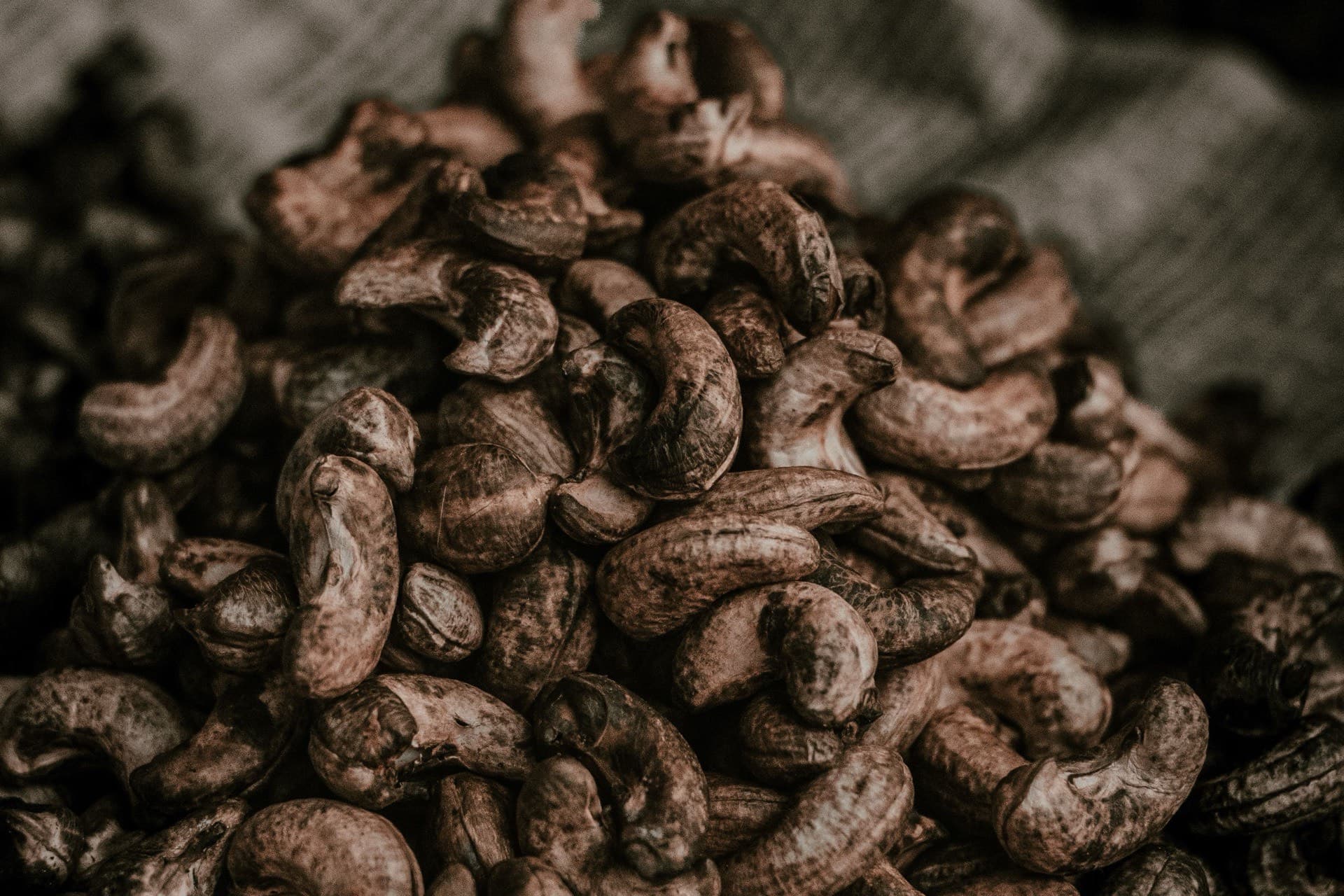
Most roasted cashews sold in Europe and North America are peeled white kernels. Vietnam is known for a second style, where the thin reddish-brown skin (the testa) stays on the kernel through roasting. The skin turns dark and papery, salt clings to it, and the nut tastes deeper, with a slightly bitter edge. The geographical indication for Bình Phước cashews, granted in 2018, covers roasted salted kernels with and without the skin.
On our catalog this product is the grade Salted Roasted Cashews with Skin, in the category "Roasted and salted", with one offer under the standard named Standard. The raw grades are on the cashew kernels page.
With the skin on, you cannot judge the roast from the outside the way you would with a white kernel, so snap a few. The inside should be cream to light gold all the way through. A brown core means the batch was roasted too hard.
How the nuts are roasted and salted
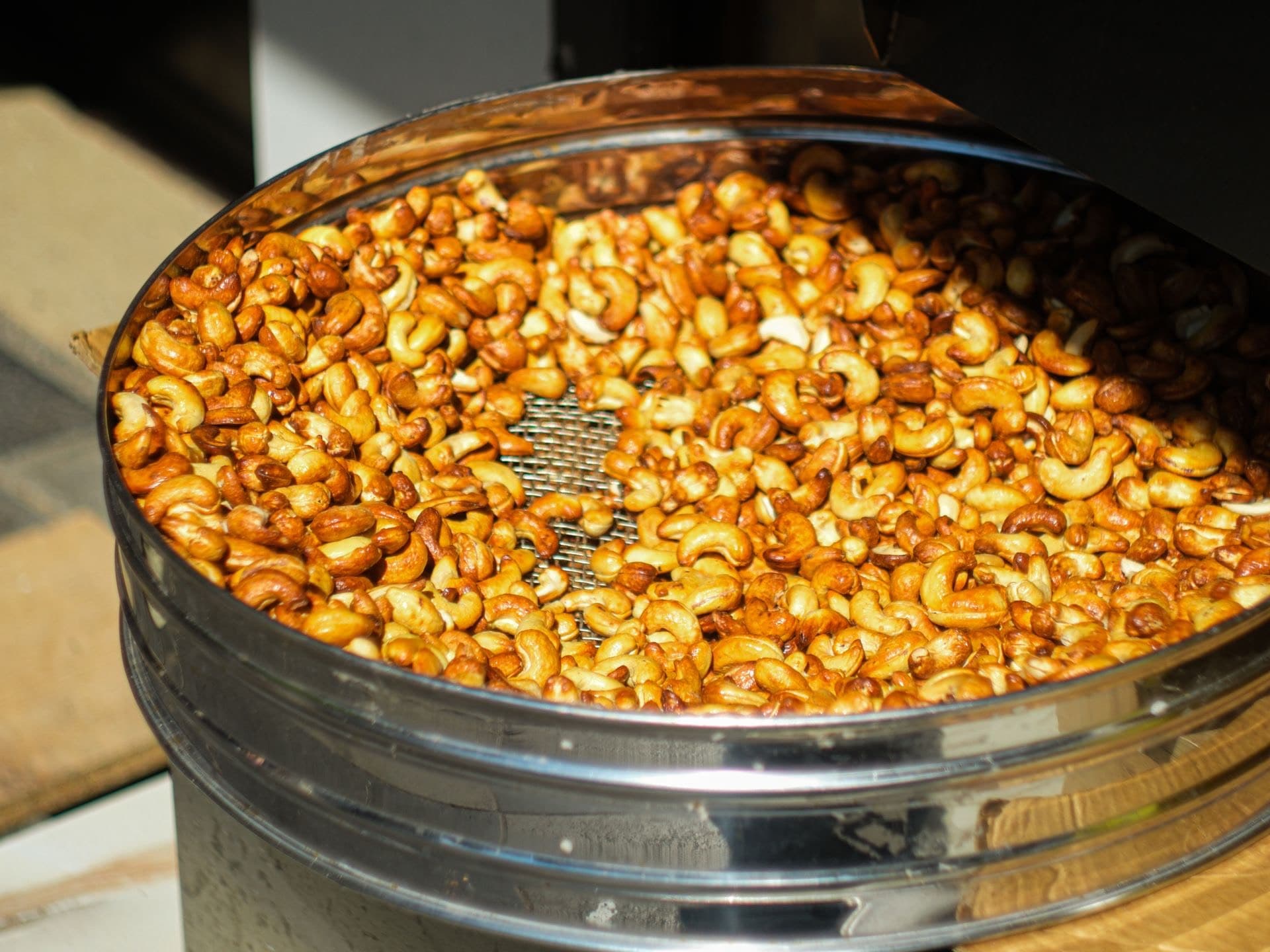
The draft East African standard for roasted cashew kernels, notified to the WTO by Kenya in 2018, names two methods: dry roasting, or frying in vegetable oil. Salt goes on as a powder or as a brine, and the label has to say which method was used.
| Dry roasted | Oil roasted (fried) | |
|---|---|---|
| What happens | Hot air or a heated drum roasts the kernel | Kernels are fried in vegetable oil |
| Ingredient list | Cashews, salt | Cashews, vegetable oil (named), salt |
| Surface | Matt, salt held by the skin or a brine coat | Glossy, salt sticks to the oil |
| Points to agree | Roast colour, salt level | Oil type, salt level, oil quality over time |
Temperature and time set the flavour and how long the nut stays fresh. In a 2019 study in the Croatian Journal of Food Science and Technology, kernels were roasted at 100 to 160°C for 20 to 60 minutes, and a consumer panel liked those roasted at 140°C for 40 to 60 minutes best. A roast pushed too far tastes burnt and goes rancid sooner.
Illustration
Roasting method, oil and salt level are set for each order. If your market or recipe needs a particular method or salt percentage, put it in your quote request and we will confirm it for your lot. For comparison, one Polish nut trader's published specification reads 98% kernels and 2% salt.
The specification to agree
The table sets our catalog next to the draft East African standard and a European trader's specification. For any nut sold to consumers in the EU, EU law sets the aflatoxin line.
| Line in the contract | Our catalog | Draft standard NC 3:2018 | A European trader's spec |
|---|---|---|---|
| Moisture | max 5% | max 2.0% | max 3% |
| Peroxide value | agreed per order | max 3.0 meq/kg | max 3.0 meq O2/kg |
| Aflatoxin B1 / total | EU law: max 2.0 / 4.0 µg/kg for nuts sold to consumers | max 5 / 10 µg/kg | max 2.0 / 4.0 µg/kg |
| Salmonella | agreed per order | absent in 25 g | not detected in 25 g |
| E. coli | agreed per order | absent | below 10 cfu/g |
| Shelf life | confirmed on the quote | not set | at least 8 months from manufacture |
Look twice at moisture. Our catalog sets 5% as the ceiling for this grade, the same as for raw whole kernels. A crisp roasted nut usually sits lower, which is why the other two specifications ask for 2% and 3%. If you want a crisper nut, or your own specification sets a lower figure, write the number into your quote request and it goes into the contract. Every limit in the table can be agreed per order.
Peroxide value measures the first stage of fat oxidation, before a nut tastes rancid. One test at loading and one on arrival show whether the fat held up in transit.
Shelf life: what eats into it
More than 40% of a cashew kernel is fat, and the Bình Phước indication sets at least 43% for its nuts. Once roasted, that fat reacts with oxygen, and this is what ends a roasted nut's shelf life. Three things speed it up:
- Oxygen. An opened bag or a leaking seal lets air in.
- Heat. The European specification above asks for storage below 20°C.
- Humidity. Salt draws water, and a roasted nut that takes up moisture goes soft. The same specification allows at most 70% relative humidity.
Light also matters for clear jars on a bright shop shelf.
Count shelf life from the production date, not the arrival date. Sea freight from Ho Chi Minh City takes weeks and the nuts then wait in your warehouse, so ask for the production date on the packing list and a best-before date on every carton. We confirm the shelf life of each lot on the quote.
Bulk packs and retail packs
Our catalog lists four bulk packs for cashew kernels, all sealed against air.
| Pack | Net weight |
|---|---|
| Vacuum PE bag | 10 kg |
| Vacuum PE bag | 11.34 kg |
| Carton of 2 vacuum bags | 22.68 kg |
| Tin can | 10 kg |
If you refill into retail jars, open one bag at a time and fill it within days. The Rotterdam importer's last two bags would have kept if they had stayed sealed in a cool room.
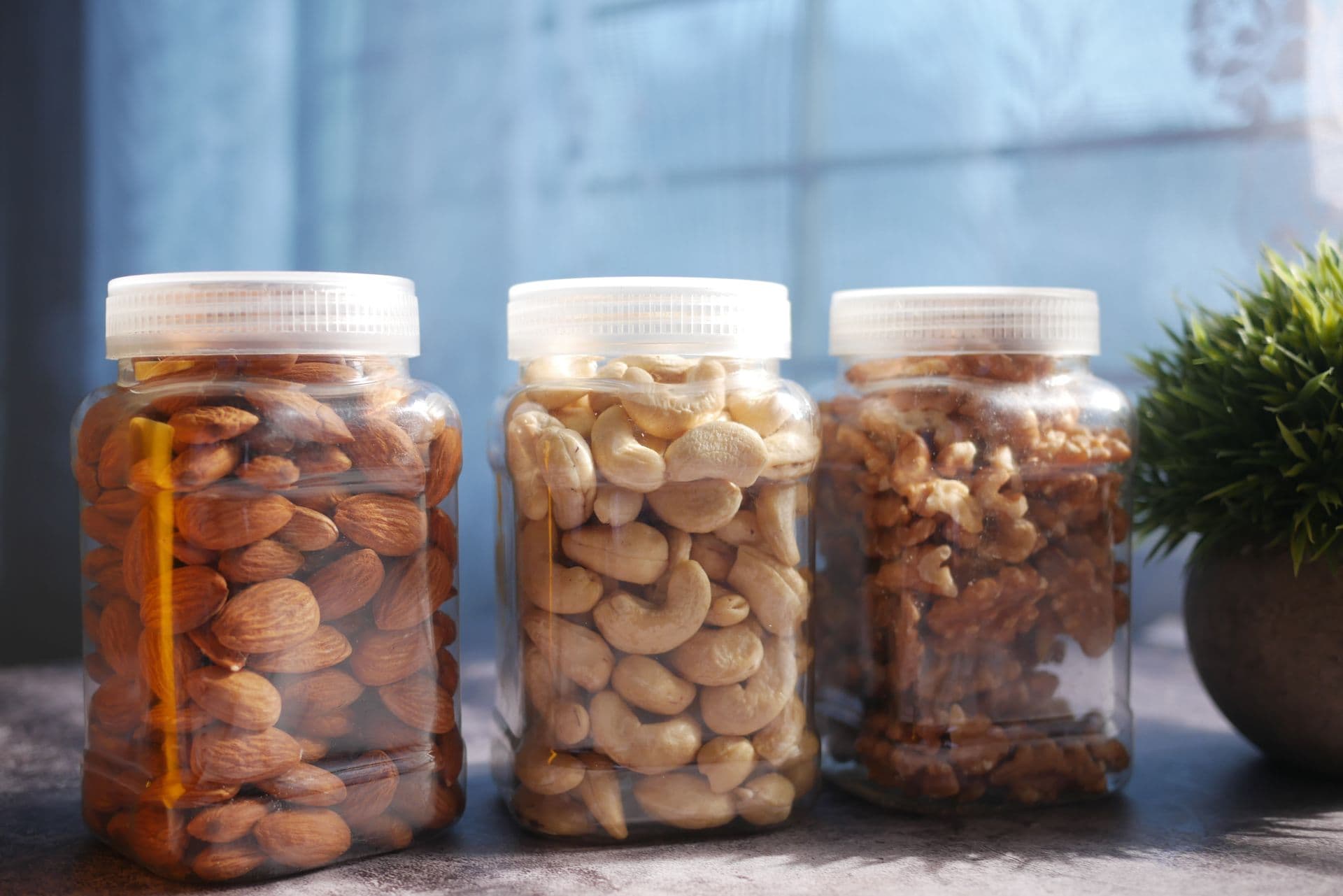
To sell straight to shops, you can have the factory pack OEM retail formats: zipper bags, plastic jars and paper boxes from 100 g to 1 kg. Send approved artwork that meets your market's label rules before the order is confirmed.
Illustration
What goes on the retail label
In the EU, Regulation (EU) No 1169/2011 sets the label rules. Cashews are on its allergen list, so the word must stand out in the ingredient list, for example in bold. The nutrition table states salt, calculated as sodium × 2.5. For oil roasted nuts, the oil is named. Leave health claims about the skin off the pack. Lab studies find the skin rich in catechin-type polyphenols, but the EU allows only health claims on the authorised list under Regulation (EC) No 1924/2006. In the United States, cashews are a tree nut allergen and must be declared on the label. Have the artwork checked against your own market's rules before printing.
Food safety documents buyers ask for
On our orders the factory is the seller named on the contract and the invoice, and the buyer pays the factory directly. Luason is the factory's authorised sales agent, so the documents below are issued in the factory's name or by the authority that inspects its goods.
| Document | What it shows | Notes |
|---|---|---|
| Commercial invoice and packing list | Goods, lots, weights, production dates | Ask for production and best-before dates per lot |
| Bill of lading | Shipment on board | Standard for FOB orders |
| Certificate of origin | Vietnamese origin | Needed for a lower duty under a trade agreement |
| Phytosanitary certificate | Plant health inspection | Not every market needs one for a roasted nut, so say whether yours does |
| Lab report (certificate of analysis) | Moisture, peroxide value, aflatoxin, Salmonella for the lot | Name the tests and the lab in the contract |
| Food safety certificates | The factory's food safety system | Ask which certificates cover the roasting line |
Customs treat a roasted nut differently from a raw one. Raw shelled cashews fall under HS 0801.32, while roasted salted cashews usually go under heading 2008, prepared nuts. US Customs, for example, used 2008.19 in ruling N228118. Your customs broker confirms the code for your country.
For the United States, the plant must be registered with the FDA, each shipment needs prior notice to the FDA, and the importer runs a Foreign Supplier Verification Program. For the EU, the list of goods under extra border checks (Implementing Regulation (EU) 2019/1793) had no entry for Vietnamese cashews in its consolidated text of August 2025. The list is revised regularly, so check the current version. If you need a document that is not in the table, tell us when you ask for a quote.
Check a sample yourself
A sample bag and a kitchen tell you most of what a lab would.
- Smell the bag as soon as you open it. Roasted and nutty is right. Paint, cardboard or old oil means oxidation.
- Snap ten nuts. They should break cleanly with a dry crack. A nut that bends has taken up moisture.
- Look at the broken faces. Cream to light gold all the way through is right, a brown core is over-roasted.
- Shake the bag and look at the bottom. Some loose skin and salt is normal for this style. A thick layer means the kernels will look patchy in a clear jar.
- Taste several nuts for salt. A bland nut next to a very salty one means uneven salting.
- Leave a handful on an open plate for a day in your own climate and taste again. That is how fast the nuts soften once your customer opens the pack.
Keep part of the sample sealed as your reference and compare the first shipment with it. You can request a free sample of up to three grades and see current offers on the price board.
Frequently asked questions
Are Vietnamese roasted cashews sold with the skin on?
Yes. Vietnam is known for the skin-on style, where the thin reddish-brown skin stays on through roasting. Our catalog grade Salted Roasted Cashews with Skin is this style.
How long do roasted salted cashews keep?
It depends on packing, storage and the roast. One European trader's specification asks for at least 8 months from manufacture, stored below 20°C and 70% humidity. We confirm the shelf life of each lot on the quote.
What moisture should roasted cashews have?
Our catalog sets a maximum of 5% for this grade. The draft East African standard asks for 2.0% and one European specification for 3%. A lower figure can be agreed per order.
Which HS code applies to roasted salted cashews?
Roasted salted cashews are usually classified under heading 2008, prepared nuts, rather than 0801 for raw kernels. US Customs used 2008.19 in ruling N228118. Your customs broker confirms the code for your country.
Sources
- National Office of Intellectual Property of Vietnam, geographical indication No. 00066 for Bình Phước cashews, 13 March 2018, as reported by IIPRD and Vietnam News (Bizhub) · bizhub.vietnamnews.vn
- Northern Corridor Standard NC 3:2018 (draft), Roasted cashew kernels, Specification, WTO SPS notification by Kenya, definition, moisture, peroxide value, aflatoxin, microbiology, labelling
- Olatidoye and others, roasting temperature and time of cashew kernels, Croatian Journal of Food Science and Technology 11 (1), 2019
- Foodcom S.A., specification Cashews Roasted & Salted, April 2025, salt, moisture, shelf life, storage, microbiology
- Commission Regulation (EU) 2023/915 on maximum levels for certain contaminants in food, aflatoxins in tree nuts, summarised by Measurlabs · measurlabs.com
- Regulation (EU) No 1169/2011 on food information to consumers, Annex II allergens, Annex I salt
- Regulation (EC) No 1924/2006 on nutrition and health claims
- Commission Implementing Regulation (EU) 2019/1793, consolidated text of 12 August 2025
- US Customs and Border Protection, ruling NY N228118 on roasted and salted cashews, 2012
- US Food and Drug Administration, Importing food products into the United States
- US Food and Drug Administration, Food allergies, tree nuts as a major food allergen
- Chandrasekara, phenolic compounds of raw and roasted cashew nuts and testa, Memorial University of Newfoundland