CN2, ME, EU and Move hand cashews: the standards compared
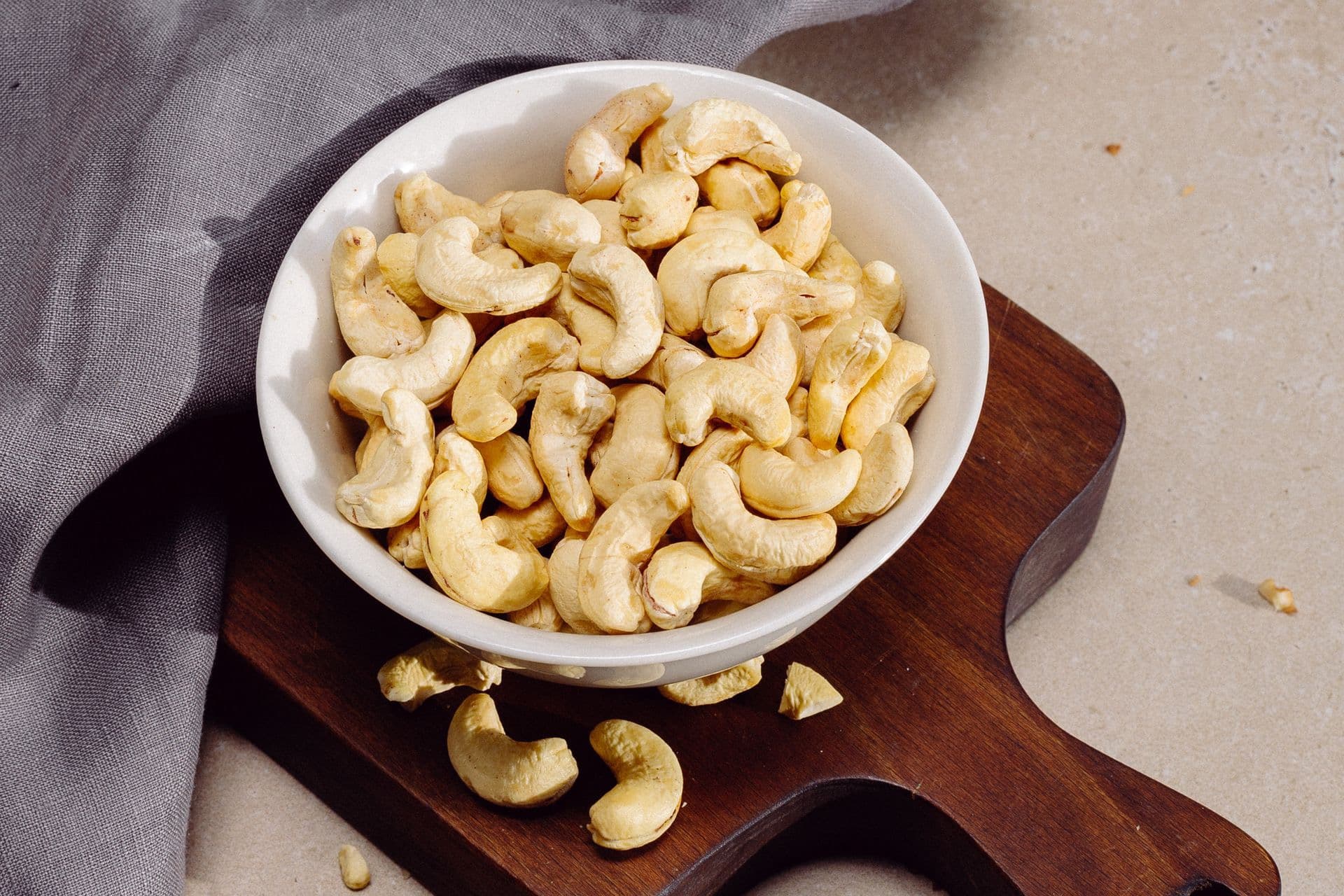
A buyer in Jeddah opens our price board to price W320 and finds it four times: W320 (EU), W320 (ME), W320 (CN2) and W320 (Move hand). Same count of 300 to 320 kernels per pound, same packing, four different prices. Her customer is a bakery that chops every kernel into a filling. If she picks the line that sounds safest, she may pay for a surface finish that ends up under a knife.
The grade code tells you the size of the kernel. The name after it tells you how the lot was sorted and where it sits on price. CN2 is the China standard, the top sort on our board and the highest price. ME comes next, then EU, sorted to what buyers in the Middle East and Europe usually ask for. Move hand is the lowest-priced line: kernels whose last bits of skin were peeled off by hand with a knife, so some show knife marks. None of the four is a law or an AFI quality class, and each one is a separate product with its own offer.
Four names on one grade
| Standard | What the name tells you | Price on our board | Whole grades on our board | Who usually buys it |
|---|---|---|---|---|
| CN2 | The China standard, the top sort | Highest | W180, W240, W320 | Buyers in China |
| ME | Sorted for buyers in the Middle East | Second | W180, W240, W320 | Importers in the Gulf and the wider region |
| EU | Sorted for buyers who sell into the European Union | Third | W180, W240, W320, W450 | Importers and packers in Europe |
| Move hand | Hand-peeled with a knife after the peeling machine, some kernels show knife marks | Lowest | W180, W240, W320 | Roasters, bakeries and processors who cut, coat or season the kernel |
W210 has its own page in the catalog but no standard line on the board yet. Splits and pieces (WS180, WS mix, LWP, SWP, BB) carry a single standard each, explained in the guide to broken cashew grades. If you need a grade in a standard the board does not show, send a quote request and we will confirm what the factory can pack for your lot.
The grade pages show the count and moisture limits that every standard of that grade shares: W180, W240, W320, W450. All of them sit on the cashew kernels page.
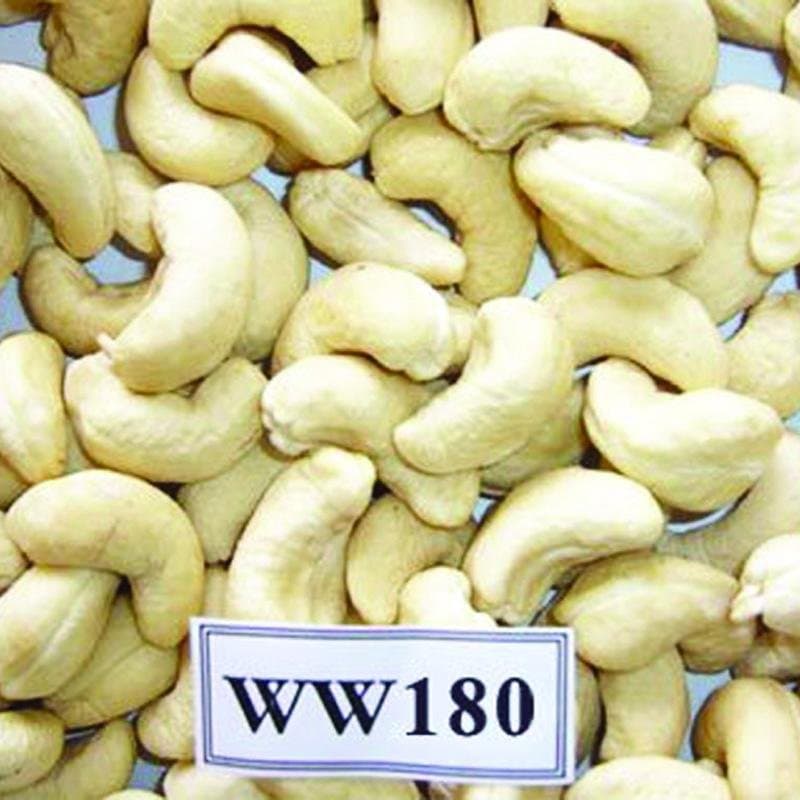
From CN2 down to Move hand
On a grade that carries all four lines, the prices run in one order: CN2, then ME, then EU, then Move hand. Every line has the same count per pound, so the gap pays for how the kernels look. That money is well spent when the kernels are sold whole and in view, in a clear retail pack or a gift box. When the kernel is chopped, ground, coated or mixed, the difference rarely shows. The buyer in Jeddah, whose bakery chops every kernel, can start from Move hand and pay less. A packer filling clear jars with plain whole kernels has a reason to look at ME or CN2.
Market names, not legal grades
No EU regulation defines an "EU grade" cashew, and no Gulf or Chinese rule defines "ME" or "CN2". They are trade names for how a lot is sorted, and on our board they also mark the price order. What the law of each market does define is a set of food-safety limits, and those apply to every cashew sold there, whatever is printed after the grade code.
Quality classes come from other places. The UNECE standard for cashew kernels, revised in 2023, sorts kernels into Extra (white), Class I (scorched) and Class II (scorched seconds or dessert). AFI, the US Association of Food Industries, uses white, scorched, scorched seconds and dessert, each with its own defect limits. Vietnam's TCVN 4850:2010 sets a moisture ceiling of 5%. The cashew specification guide puts these numbers side by side.
So a market name is a promise about sorting on top of the general limits. The factory sorts the lot with a destination in mind and confirms the details for each order. If your contract needs a colour class, a defect cap or a lab limit in numbers, write it in next to the grade and the standard, and ask for it when you request a quote.
EU: what a European buyer has to pass
The rules below come from EU law and apply to any cashew placed on the EU market.
Regulation (EU) 2023/915 caps aflatoxin B1 at 5 µg/kg and the sum of B1, B2, G1 and G2 at 10 µg/kg for tree nuts that will be sorted or treated before they reach consumers. For nuts sold to the final consumer or used as an ingredient the caps are 2 and 4 µg/kg. Pesticide residues fall under Regulation (EC) No 396/2005, and where it sets no specific level for a substance, a default of 0.01 mg/kg applies.
On the label, cashew is one of the allergens that must be highlighted under Regulation (EU) No 1169/2011, and Regulation (EU) 2018/775 asks for the origin of the main ingredient when it differs from the origin the label suggests.
EU law does not require a food-safety certificate, but almost every European importer asks for a GFSI scheme such as BRCGS, IFS or FSSC 22000. The factory's documents list ISO 9001:2015, HACCP and BRC. Tell us which certificate your customer needs and we will send the current copies with your quote.
An EU lot is sorted with this buyer in mind. A buyer in Europe who orders another standard still gets cashews that have to meet the same law at the border.
ME: what Gulf importers check
In the Gulf states the Gulf Standardization Organization (GSO) writes the food rules. GSO 9 covers the labelling of prepackaged food: the label has to be in Arabic, with a second language allowed next to it, and it has to give the product name, net contents, country of origin and the other set details. GSO 150 deals with expiry dates, and a separate GSO regulation sets aflatoxin limits. Many importers in the region also ask for a halal certificate.
When bulk kernels are repacked in the destination country, the Arabic retail label is usually the importer's job. The halal document, the shelf-life date and the lab report have to come from Vietnam. Name them in your quote request and we will confirm what the factory issues for your lot.
CN2: what a shipment to China needs
China treats a cashew factory abroad as a food producer that must be registered with its customs authority (GACC). GACC Decree No. 280 replaced Decree No. 248 on 1 June 2026, and "nuts and seeds" remain on the list of foods whose overseas producers must be recommended by the authority of their own country before they can register. Chinese national standard GB 2761 sets the mycotoxin limits that imported nuts are tested against.
CN2 is the China standard, the top sort on our board and the highest price of the four. If you buy CN2 for China, ask for the factory's registration status with the offer. If you buy it for another market because the look suits you, the food law of your own market applies, as with any other standard.
Move hand: the kernels with knife marks
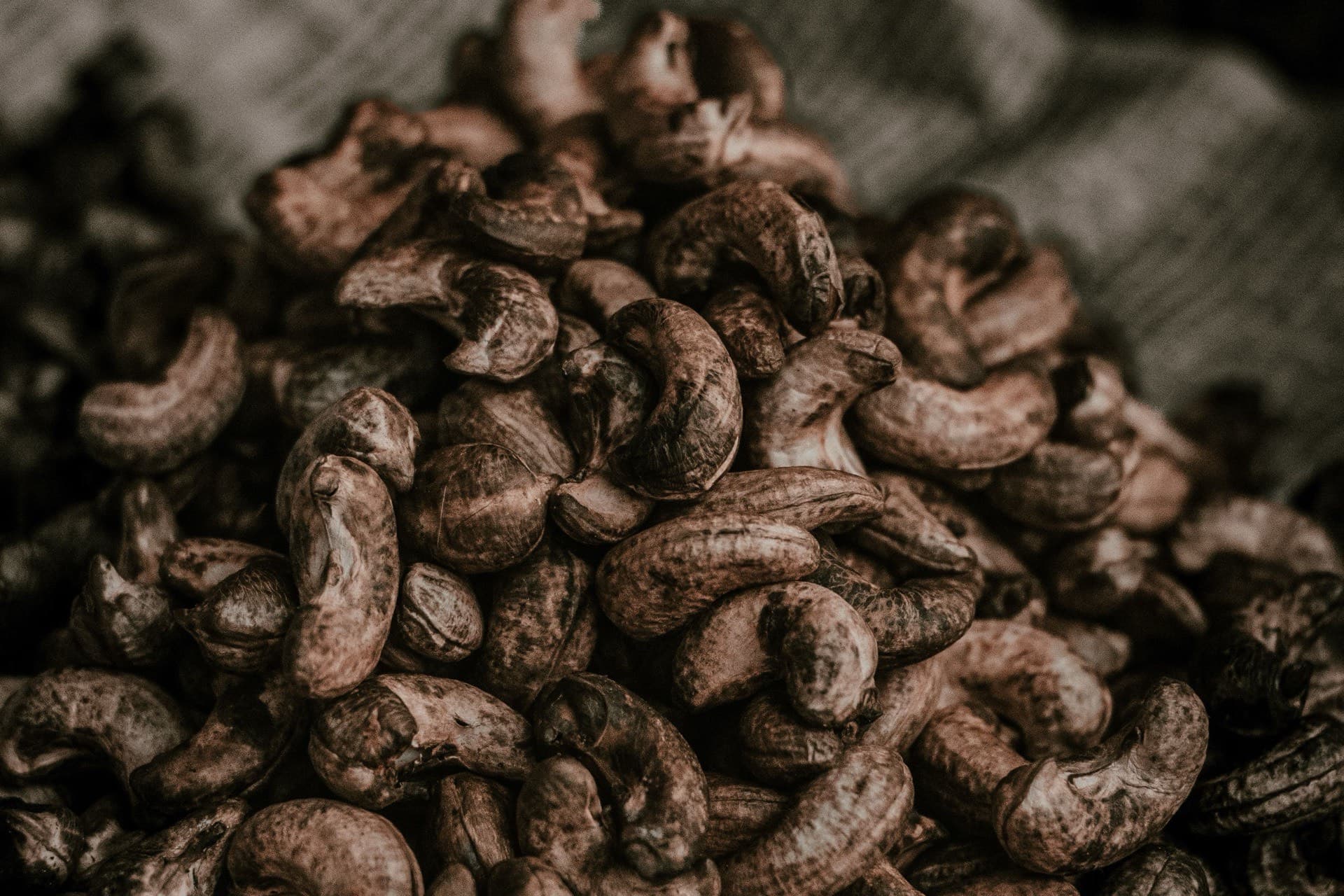
Move hand is Luason's own term, and it does not appear in AFI or UNECE. It is the lowest-priced standard on our board. After shelling, kernels pass a machine that peels off the testa, the thin reddish skin. Some kernels come out with skin still on them. Workers gather those kernels and pare the skin off with a knife, so some of them keep a knife mark where the skin was. A Move hand lot is made of these hand-finished kernels.
AFI's definitions show what that means in practice. AFI scores a kernel as "scraped" when knife scratches cover more than 5 mm in total, and it does not count scrapes on the inside of the kernel's curve. Deeper cuts that change the shape count as superficial damage, allowed up to 1% in first quality, 2% in second and 5% in third. The marks also matter after roasting. AFI notes that scraped areas turn out lighter than the rest of the kernel and give the roast an uneven look, and it calls a roast uneven when more than 10% of the kernels show scrapes.
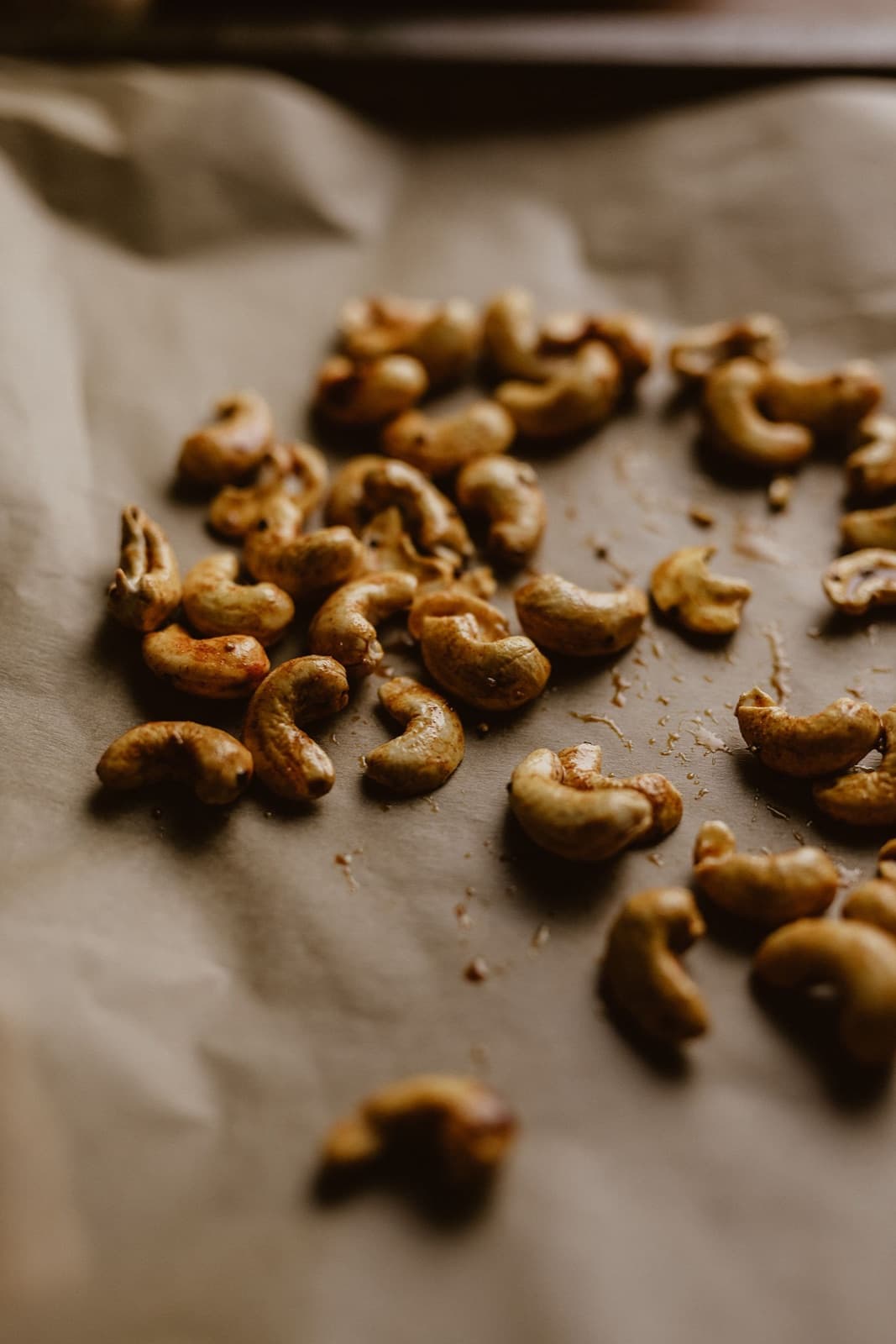
For many uses a knife mark makes no difference: chopped nuts in a bakery filling, cashew butter, a honey or spice coating, a stir-fry, a mix where the kernel is cut or covered. For whole kernels sold plain, roasted or raw, in a clear pack, compare a Move hand sample with another standard before you decide.
Illustration
Put two standards side by side
The quickest way to choose is to look at two standards of the same grade on one table. Our free sample request takes up to three items, 100 g to 1 kg each, so W320 (EU), W320 (CN2) and W320 (Move hand) can arrive in one parcel.
- Count out 100 whole kernels from each sample and spread them on a dark tray in daylight.
- Turn every kernel to its outer curve. Set aside the ones with flat, shaved-looking patches or knife lines larger than about 5 mm in total. Count them. That count, out of 100, is your scrape rate.
- Compare colour across the samples. Look for yellow or brown tones, scorched tips and spots.
- If you will roast, fry 50 kernels from each sample for 2 to 3 minutes in clean vegetable oil at about 149°C, as in AFI's roast test, and let them cool. Scraped areas show up as lighter patches.
- Taste a few kernels and smell a freshly opened bag for rancidity.
- Keep what is left of the sample you choose, sealed and labelled. It is your reference when the shipment arrives.
The guide to checking a cashew sample goes through the full routine.
Writing the standard into the contract
Copy the grade and the standard exactly as they appear on the offer, for example "W320 (Move hand), 300 to 320 whole kernels per lb". Add the numbers that matter for your use: moisture, broken, the colour class, the scrape or defect cap, and the lab limits of your market. Then tie the contract to a sealed sample of that grade and standard. AFI recommends two sealed pre-shipment samples, one kept closed for a possible dispute.
Each standard has its own line and its own price on our price board. When you are unsure which one fits, describe what your customer does with the kernels when you contact us, and we will suggest a standard and confirm the specification for your lot.
Frequently asked questions
Is EU grade cashew an official European standard?
No. "EU" on our board is the factory's name for a lot sorted for European buyers. EU law sets limits for aflatoxins, pesticide residues and labelling that every cashew sold in the EU must meet, whatever the standard name.
Which cashew standard costs the most?
CN2, the China standard, is the top sort and the highest price on our board. ME comes next, then EU, and Move hand is the lowest. Pay for the higher lines when your customers will see the whole kernel, and save when the kernel is cut, coated or ground.
What does Move hand mean on a cashew offer?
Move hand kernels kept part of their skin after the peeling machine and were finished by hand with a knife, so some of them carry knife marks. It is Luason's own term, not an AFI class, and the lowest-priced standard on our board.
Can I buy an EU or CN2 lot for a different market?
Yes. The name describes how the lot was sorted, not who may buy it. The food law of the country where you sell applies in every case, so name your market when you ask for a quote.
Which standard should I choose for roasting?
It depends on how the roast is sold. Knife marks show as lighter patches after roasting, which matters for plain roasted whole kernels and much less for coated, seasoned or chopped products. A roast test on two samples settles it.
Why does W210 not show all four standards?
The board lists the lines the factory offers at the moment. For a grade and standard that are not listed, send a quote request and we will confirm what can be packed for your order.
Sources
- Association of Food Industries (AFI), Specifications for Cashew Kernels, updated September 2023, defect definitions (scraped, adhering testa, superficial damage), roast test and roast defects, sealed pre-shipment samples
- CBI (Netherlands Ministry of Foreign Affairs), "Entering the European market for cashew nuts", updated March 2026, EU aflatoxin limits, allergen and origin labelling, buyer certification, UNECE classes and moisture
- Measurlabs, "EU regulations on food contaminants", aflatoxin limits for other tree nuts under Regulation (EU) 2023/915, lower limit for direct consumption
- European Commission, EU legislation on maximum residue levels of pesticides, Regulation (EC) No 396/2005 and the default limit of 0.01 mg/kg
- TCVN 4850:2010, Specification for cashew kernels, bilingual text published by Vinacas
- Gulf Standardization Organization, GSO 9 Labeling of prepackaged food stuffs
- Kingdom of Bahrain Ministry of Health, General restrictions and requirements for prepackaged food labels (GCC rules, Arabic language)
- Singapore Food Agency, trade circular on GACC Decree No. 280, July 2026, effective 1 June 2026, nuts and seeds on the list needing competent authority recommendation
- USDA Foreign Agricultural Service, China releases standard for maximum levels of mycotoxins in foods (GB 2761-2017)