How to evaluate a cashew sample before you order
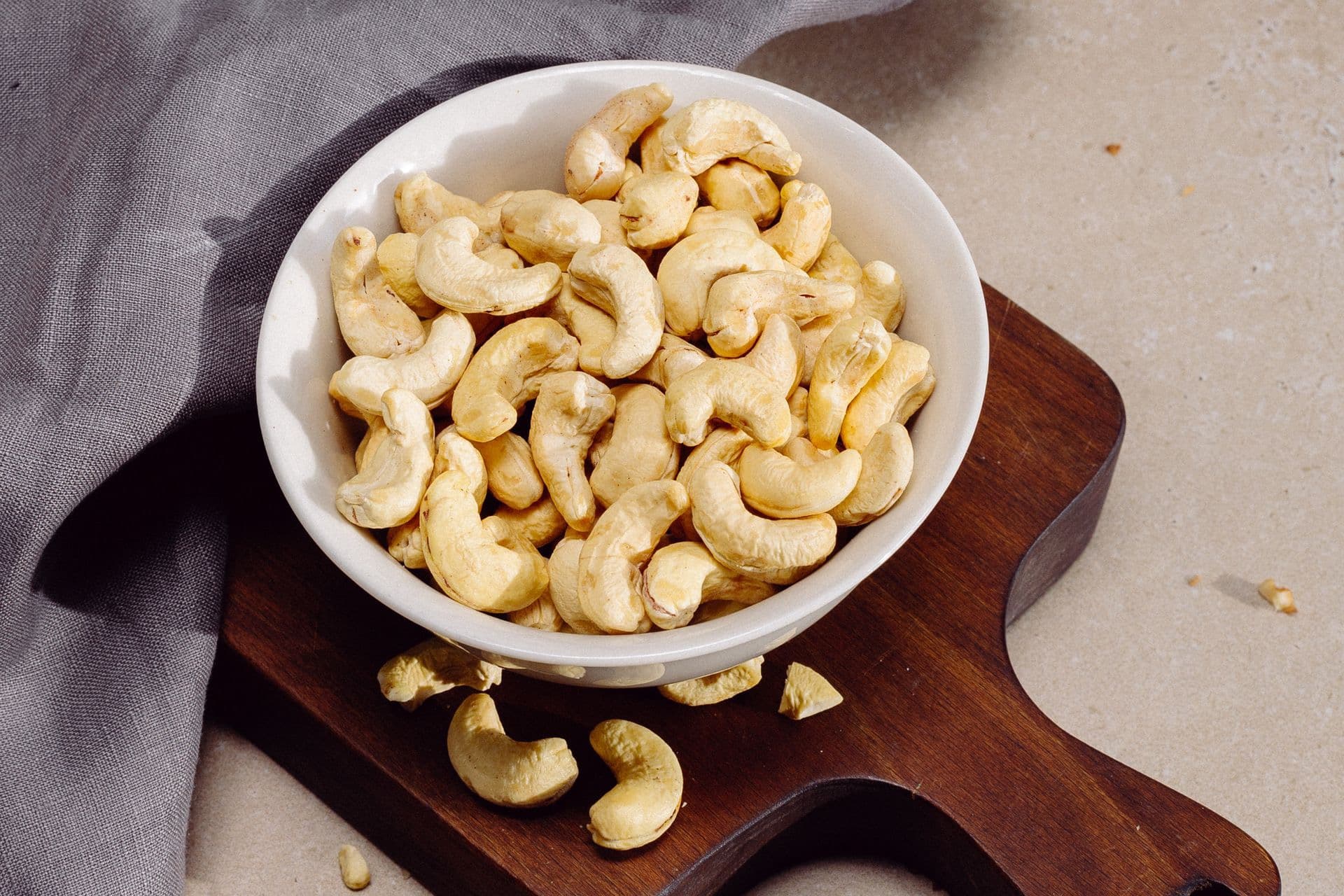
A buyer in Riyadh orders samples of three grades, and the parcel lands on a Tuesday. By Thursday the office has eaten most of the W320. Everyone liked it, so the contract is signed on that grade. Two months later the container arrives and the kernels in the first carton look a shade darker than people remember. Nobody can check, because all that is left of the sample is a few broken pieces in an open bag.
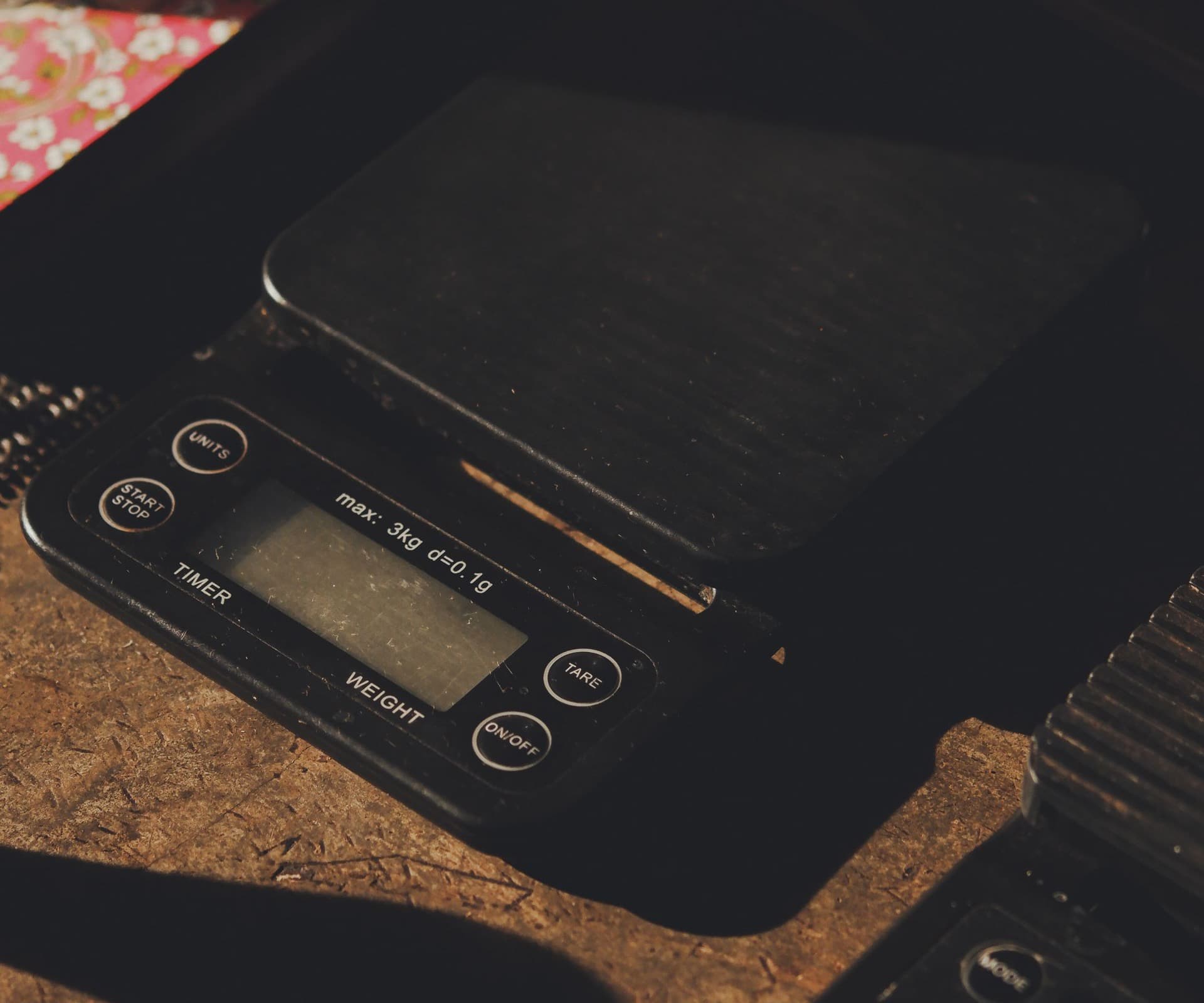
To evaluate a cashew sample, check it in a fixed order and write the results down: label, smell, colour, count, broken kernels, defects, moisture, taste and insects. Before any of that, seal part of the sample away as a reference, so the shipment can later be laid next to real kernels. You need a kitchen scale, a white tray and good light.
What arrives in a Luason sample parcel
On the sample form you can ask for up to three grades in one parcel, 100 g, 300 g, 500 g or 1 kg of each. Samples are free, courier included, and one parcel goes to each address per month, because every sample is a real shipment. You confirm your address by email, we pack the parcel within three working days and email you the tracking number.
Each line on the form is a grade in one standard, as on the price board, so W320 (EU) and W320 (Move hand) are two lines. Three lines let you set two standards of the same grade side by side, or two sizes in one standard. The guide to EU, ME, CN2 and Move hand explains how the standards differ.
How much to ask for
The checks below follow the analytical method of the US Association of Food Industries (AFI), scaled down. AFI counts whole kernels in 454 g (one pound), judges breakage in 1,000 g and defects in 500 g, and examines at least 200 whole kernels for insect damage.
| Amount per grade | What you can do with it |
|---|---|
| 100 g | Look, smell and taste, compare colour with another grade. Too little for a count. |
| 300 g | All of that, plus a count scaled up to a pound and a rough broken percentage. |
| 500 g | A full 454 g count, with broken kernels and defects sorted from the same kernels. |
| 1 kg | All of that, a sealed reference half, and kernels for a roast test. |
Ask for 1 kg of the grade you are most likely to buy and smaller amounts of the grades you compare it with.
Check it in this order
Start with the checks that change nothing and end with the ones that use kernels up.
1. Before you open the bag
Check that the label matches what you asked for, grade and standard both. Look at the seal, weigh the bag and take a photo.
2. Split off the reference
Before anyone tastes, pour about half of the grade you plan to buy into a clean airtight jar or bag, close it, label it and put it away. Storage is covered further down.
3. Smell
Smell the kernels as soon as the bag is open. Fresh cashews smell faintly sweet and nutty. AFI requires kernels free of off-tastes and off-aromas and defines rancidity as a breakdown of the oils that gives an off-flavour or aroma. If the bag smells of old frying oil, paint, damp cardboard or mould, ask about it before you go further.
4. Colour, in good light
Spread the kernels in one layer on a white tray. AFI requires colour to be judged under full-spectrum light, and in an office daylight by a window comes closest. AFI describes first-quality kernels as white, light yellow or pale ivory, of uniform colour. Second quality runs to yellow, light brown, light ivory, light ash-grey or deep ivory. Look at how even the colour is as well as at the shade. Photograph the tray next to a sheet of white paper so the picture can be compared later.
5. Count
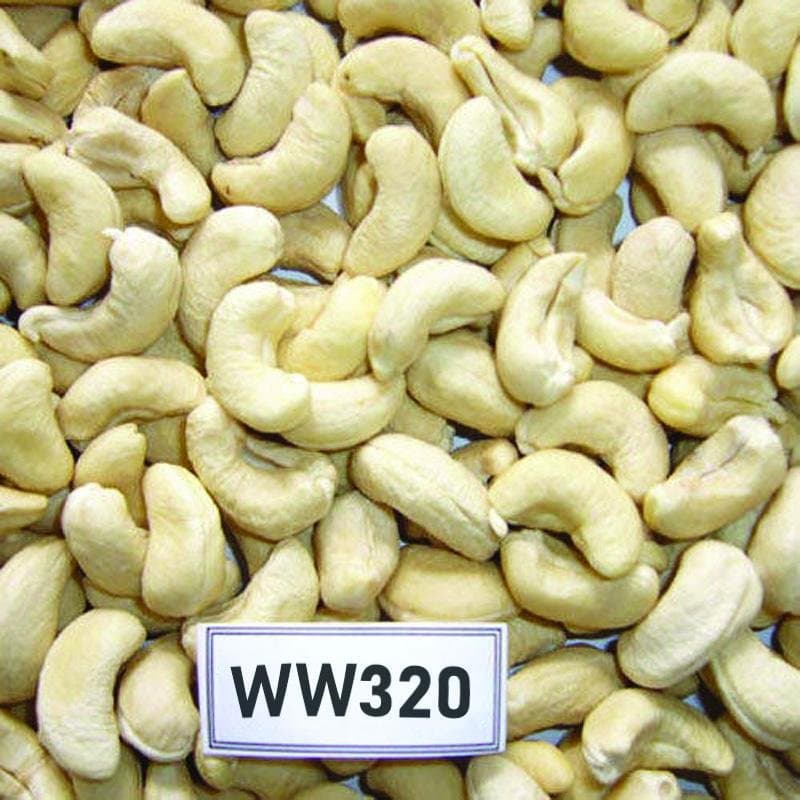
Weigh 454 g of whole kernels and count them. Our catalog sets W320 at 300-320 per pound and W240 at 220-240. With 300 g, count what you have and multiply by 454 divided by the weight. The guide to cashew kernel grades has the full count table.
Illustration
6. Broken kernels
Pick out every split, butt and piece and weigh them. 38 g of broken in 500 g is 7.6%. Our general limit for whole grades is 10% by weight, the same as AFI's. For splits and pieces bought as grades of their own, the guide to broken cashew grades shows how to sieve them.
7. Defects
Go through the whole kernels and set aside the faulty ones. AFI's list makes a good checklist: scorched kernels, spots over 3 mm in aggregate, pitted black or brown spots over 1 mm, shrivelled or immature kernels, adhering testa (the thin reddish skin) over 2 mm, and knife scrapes over 5 mm. Weigh the pile. A kernel with two faults counts once, under the worse one.
Judge each sample against its own standard. Move hand kernels kept some testa after the peeling machine and were then peeled by hand with a knife, so knife marks belong to a Move hand lot and are not a fault in that sample. AFI notes that scraped areas come out lighter after roasting, so if you roast, put some Move hand kernels into the roast test in step 10.
8. Moisture, by feel and by lab
A dry kernel snaps cleanly when you bend it. One that bends, feels leathery or crumbles soft deserves a moisture test. Treat the snap as a rough sign only. AFI measures moisture as loss on drying at 105°C and asks for 3% to 5%. Our catalog sets a maximum of 5% for whole grades and 4.7% for splits and pieces. If you have a lab, send it about 50 g from the tested portion and leave the reference sealed.
9. Taste and insects
Chew kernels from different parts of the tray, the plain-looking ones too. A good kernel is crunchy and mildly sweet. A bitter, soapy or stale aftertaste points to oil breakdown, and a lab can confirm it with free fatty acids and peroxide value, for which AFI's limits are 1.5% and 5 meq/kg.
AFI permits no live infestation, and its definition of insect damage includes traces in the packaging: frass, webbing, boring and powdery residue. Tip the empty bag over a sheet of dark paper and look at what falls out. Then snap 20 or 30 kernels along the natural seam where the two halves meet and look inside for tunnels or mould.
10. A roast test, if you roast
AFI's roast test uses clear vegetable oil at about 149°C for 2 to 3 minutes, stirring several times. Spots that hide on a raw kernel come out as brown marks and scrapes as pale patches. For cashews bought already roasted and salted, see the guide to roasted salted cashews.
Write it down on one card
Use one card per sample, and the same card for the shipment later.
| Line on the card | Example entry |
|---|---|
| Grade and standard | W320 (EU) |
| Smell | fresh, no off-notes |
| Colour | white to pale ivory, uniform, photo 3 |
| Count | 312 per 454 g |
| Broken | 38 g in 500 g = 7.6% |
| Defects | 14 g in 454 g = 3.1%, mostly small spots |
| Moisture | snaps cleanly, no lab test |
| Taste | sweet, crisp, no aftertaste |
| Insects | none, no powder in the bag |
| Reference | 500 g, jar 7, fridge |
Send the card's figures with your quote request. If you like the sample but need a tighter limit, for example less broken or lower moisture, say so. Specifications can be agreed per order, and we will confirm the figures for your lot.
The reference sample
AFI cites the Postharvest Center of the University of California: tree nuts keep best at 0 to 10°C and 55% to 70% relative humidity. The cargo handbook of the German insurers' association adds that cashews take up pungent smells and should be kept in the dark, protected from oxygen and metal. In practice, use a full airtight jar or a squeezed-out zip bag in a fridge without onions, coffee or spices. Label it with grade and standard, date received, quote number and card number, and keep it until the shipment it stands for has arrived, been checked and any quality question is closed.
The courier sample shows the offer you chose. The lot is produced later, and AFI covers that with pre-shipment samples: two sealed samples from the actual lot go to the buyer for approval, one stays sealed in case a quality dispute goes to arbitration, and a delivery is acceptable when it is equal to or better than the approved sample. The guide to cashew contract specifications shows how to write that into the contract with the limits.
Comparing the shipment with the reference
When the container arrives, draw kernels from several cartons, from three or more spots in each, and mix them, as AFI's sampling plan does. Run the same checks in the same order, on the same tray, in the same light, with the same scale, and photograph both trays side by side.
| Gap you find | Possible causes |
|---|---|
| Count above the range | smaller kernels mixed in, a different grade |
| Broken over the limit | rough handling, or kernels dried too far |
| Darker or uneven colour | scorched kernels, a lower quality class, ageing |
| Soft kernels | moisture taken up in transit, a failed seal |
| Off smell | rancidity, taint from other cargo, poor storage |
Some causes start at the factory and some on the way. Photograph the carton lot codes and any damaged bags, keep the cartons, and send us your figures and photos with those of the reference. We take them up with the factory, which is the seller on your contract.
Frequently asked questions
Are Luason cashew samples free?
Yes. Up to three grades per parcel, 100 g to 1 kg of each, courier included. One parcel goes to each address per month, and you confirm your address by email before we pack it.
How much cashew sample should I ask for?
At least 500 g of the grade you plan to buy, so you can count a full pound. 1 kg also leaves a sealed reference half. 100 g is enough to compare colour and taste between grades.
Does an approved sample guarantee the shipment?
The courier sample helps you choose the grade and standard. The quality of the lot is set by the specification in the contract and, as AFI recommends, by sealed pre-shipment samples drawn from the lot itself.
Sources
- Association of Food Industries (AFI), Specifications for Cashew Kernels, updated September 2023, sensory, colour, defects, insect damage, analytical method, moisture, FFA and PV, storage, roast test, sealed samples
- Transport Information Service (TIS) of the German Insurance Association (GDV), Cashew nuts, odour sensitivity and storage