Cashew grades explained: W180, W210, W240, W320, W450
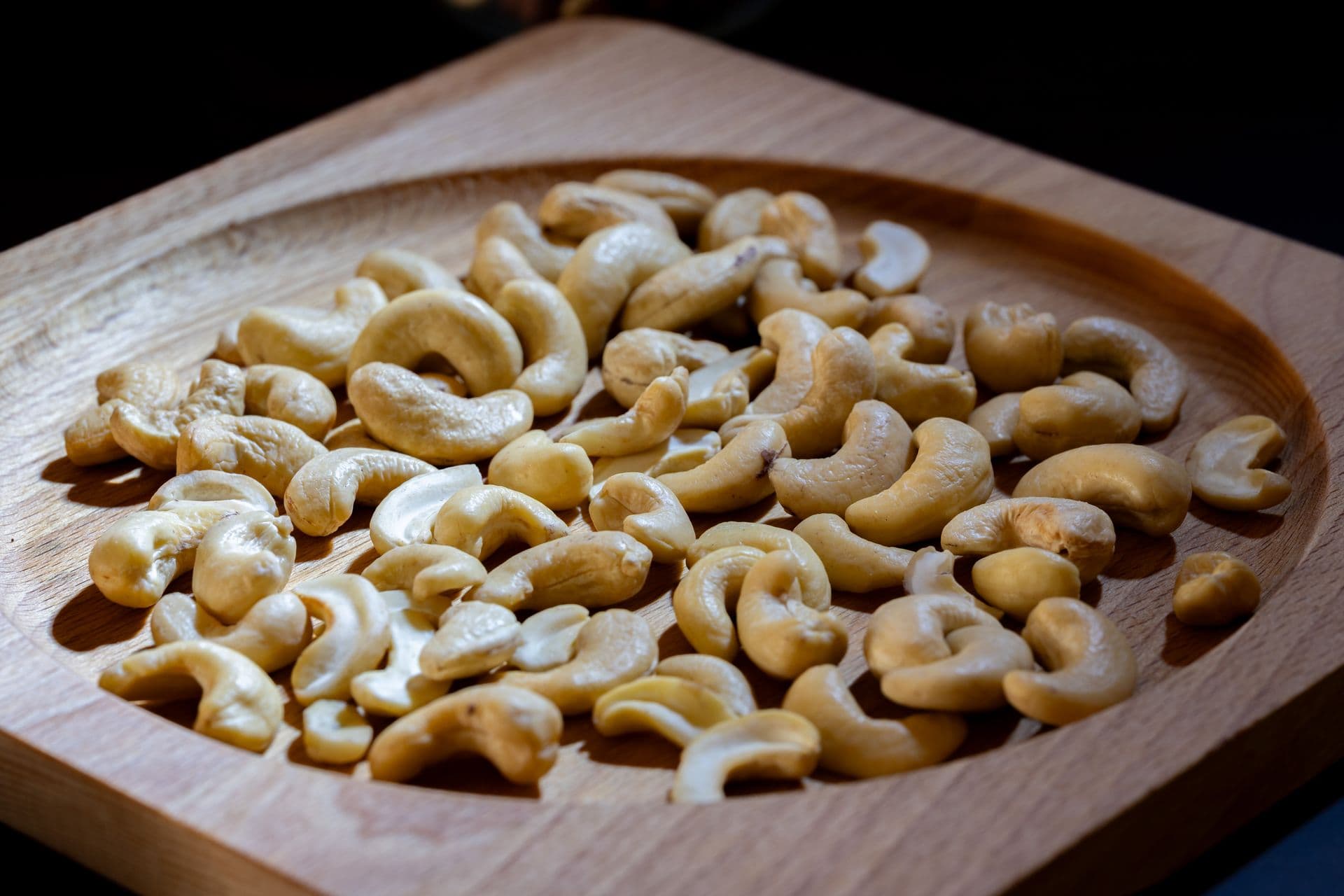
Picture a buyer in Rotterdam opening the first carton of a new supplier's lot. The contract says W320. The kernels look fine, white and whole, but smaller than last season's. She weighs out a pound, counts, and gets 410. A count of 410 belongs to W450, a grade that trades lower, and nobody will refund the difference unless the contract says how the count is measured.
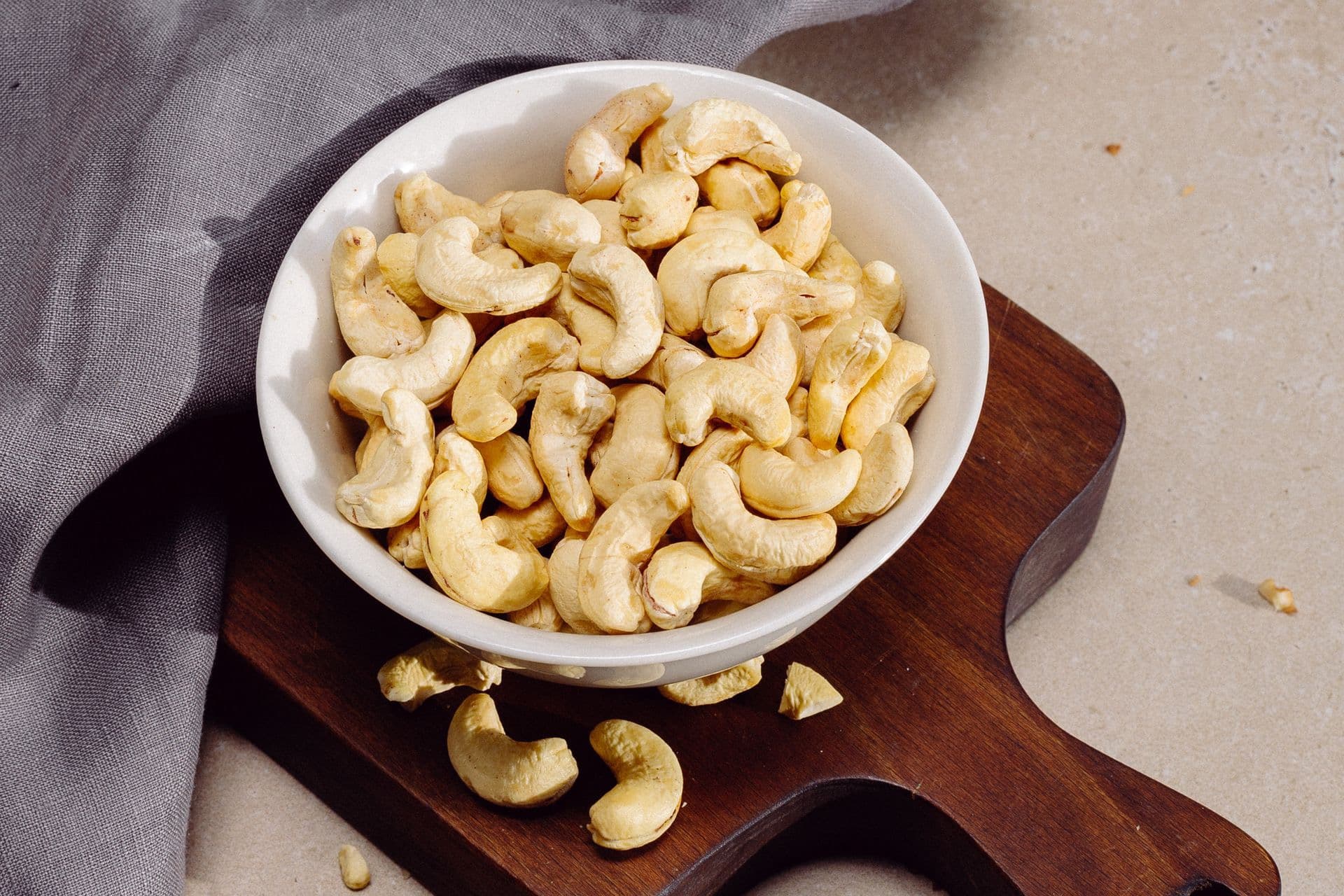
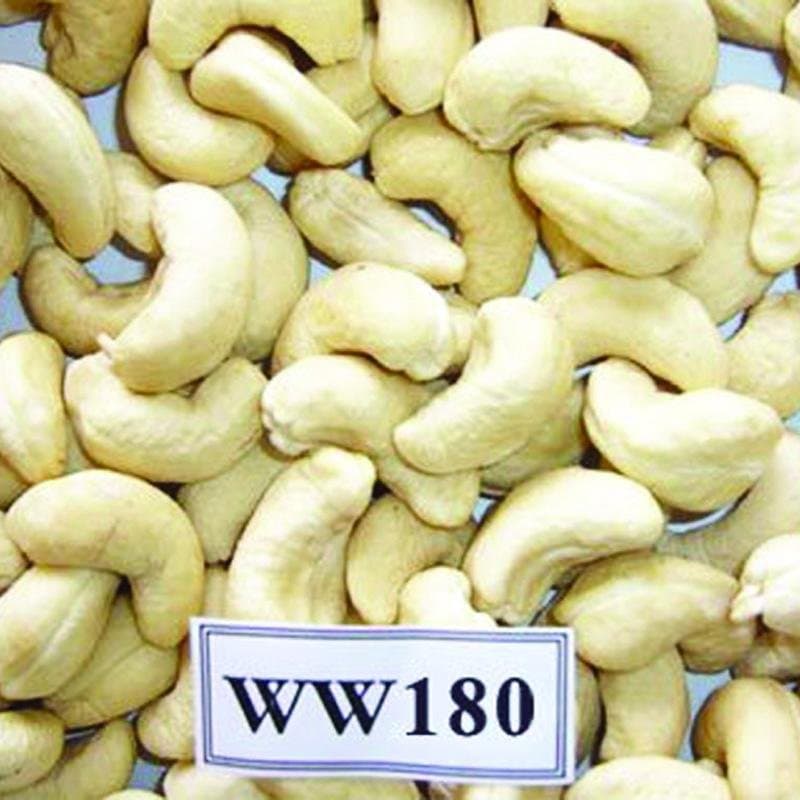
The number in a cashew grade is a count. W320 means whole white kernels at roughly 300 to 320 to the pound (454 g). The smaller the number, the bigger the kernel: W180 is the largest whole grade in common trade, W450 the smallest. Checking it takes about ten minutes at the warehouse, and the method is further down.
What the letters and numbers mean
Read W320 in two parts.
- W stands for whole, and in practice for "white whole". The US Association of Food Industries (AFI) treats a kernel as whole when it keeps the characteristic cashew shape and no more than one eighth of it has broken off. Some sheets write the same grade as WW320, so W320 and WW320 name the same thing.
- 320 is the upper end of the count range, the most kernels allowed in one pound. A lot of W320 should count no more than 320 whole kernels per 454 g, and no fewer than 300.
Broken kernels have codes of their own (splits, butts and pieces such as WS, LWP and SWP) and get a separate guide. This one stays with whole kernels.
The five whole grades side by side
The table puts the count ranges on Luason's catalog next to the AFI ranges, with what one kernel weighs on average. The weight column is plain arithmetic: 454 g divided by the count.
| Grade | Count per lb (Luason catalog) | Count per lb (AFI) | Average kernel weight | Count per kg (approx.) |
|---|---|---|---|---|
| W180 | 160-180 | 140-180 | 2.5-2.8 g | 353-397 |
| W210 | 190-210 | 180-210 | 2.2-2.4 g | 419-463 |
| W240 | 220-240 | 220-240 | 1.9-2.1 g | 485-529 |
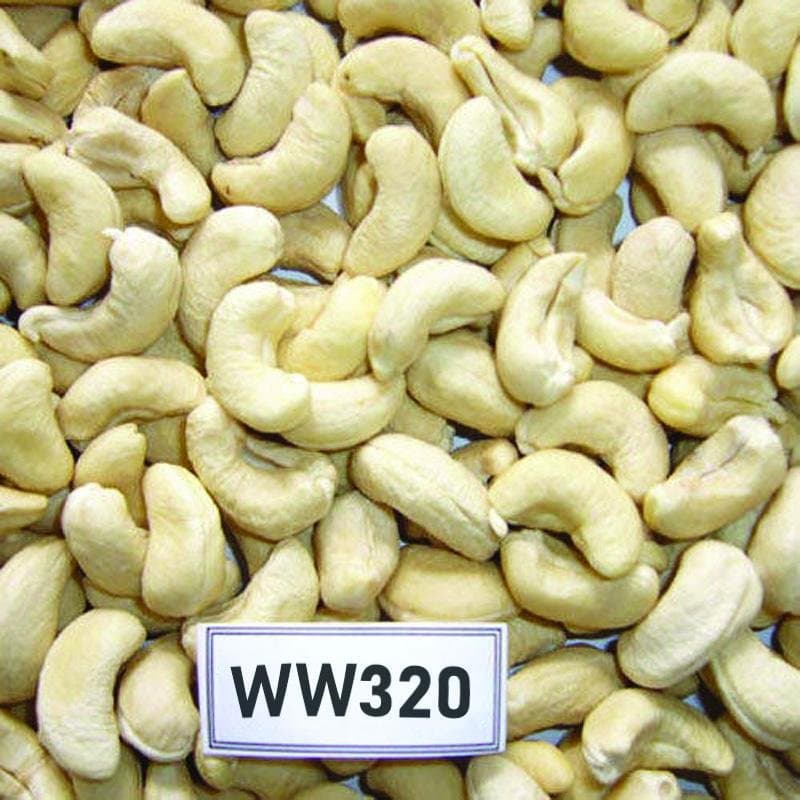
| W320 | 300-320 | 300-320 | 1.4-1.5 g | 661-705 |
| W450 | 380-450 | 400-450 | 1.0-1.2 g | 838-992 |
A W180 kernel weighs nearly three times as much as a W450 kernel, which is a bigger gap than the codes suggest at a glance. The bands also differ between specifications. AFI's W180 runs down to 140 per pound, while the range we quote stops at 160. A lot counting 185 per pound fits AFI's W210 band but sits between our W180 and W210 ranges. Counts like that are settled order by order: if your spec follows the AFI bands, put the range in your quote request and we will tell you which grade covers it. Either way, the contract should carry the count range in numbers as well as the grade code.
The general limits on the catalog apply to every whole grade: moisture at most 5% and broken kernels at most 10%. AFI adds a size tolerance, under which kernels of the next smaller size grade may make up no more than 10% of the weight.
Which grade for which job
Size changes how a kernel is used and how it looks in the pack. A rough map of the trade:
| Grade | Where it usually ends up |
|---|---|
| W180, W210 | Premium retail, gift packs and tins, where a few large kernels are the selling point |
| W240 | Premium retail packs and roasted lines that want a large, even kernel |
| W320 | Everyday retail packs, roasting and salting, snack mixes, food service |
| W450 | Snack mixes, roasting and salting where price per kilo matters more than kernel size |
Bakery and confectionery mostly buy splits and pieces, since the kernel gets chopped anyway.
One way to choose is to think about how many kernels the end customer sees at once. In a 100 g window bag of plain cashews every kernel is on display, and W240 or W320 looks generous. In a trail mix, where cashews share space with raisins and almonds, a W450 kernel is in proportion with the rest, and paying for W240 buys size nobody notices.
Each grade has a page with photos and a specification sheet: W180, W210, W240, W320 and W450. All grades, broken ones included, are on the cashew kernels page.
Why W320 is the most traded grade
Ask a cashew trader for "the price" and you will usually get the W320 price. Trade sources commonly name it the most traded grade, and price reporting follows the same habit: Expana's benchmark for Vietnamese cashews is WW320 FOB Vietnam.
Part of the reason is use. A kernel of about 1.5 g is big enough to look like a proper cashew in a retail pack and small enough to sit well in mixes and roasting batches, so few buyers rule it out. The other part is habit feeding on itself. Because everyone quotes W320, it is the easiest grade to compare between offers and between weeks, and buyers new to cashews often start there for that reason. The large grades, W180 and W210, sit at the premium end and are priced that way.
Vietnam ships most of the world's cashew kernels. Vinacas, the Vietnam Cashew Association, puts its share of world kernel exports above 80%.
Our price board shows the current FOB offers for each grade and standard. Guides leave prices out because they change every week.
Illustration
Check the count yourself with a 454 g sample
A grade code is a promise about count, and count is easy to check. AFI's method counts whole kernels in a one-pound (454 g) composite sample. The same idea works at warehouse scale.
- Draw a fair sample. Take kernels from several cartons, from the top and from deeper in the bag, and mix them. One carton only tells you about that carton.
- Pick out splits, butts and pieces and set them aside. Weigh them later if you want to check the 10% broken limit.
- Weigh 454 g of whole kernels on a scale that reads to 1 g.
- Count them. Laying them out in rows of ten on a tray is faster than it sounds and makes a recount easy.
- Compare with the contract range. For W320, a result between 300 and 320 is on grade. A count above the top of the range means the kernels run small. A count well below the bottom means the kernels are larger than the grade calls for, which buyers seldom mind, though it is worth a note in your records.
If you buy in metric and your spec is per kilogram, multiply the per-pound count by 2.2. A W320 lot should count about 660 to 705 kernels per kilogram.
The 50-kernel shortcut
When there is no time to count a full pound, weigh 50 whole kernels. The figures follow straight from the count ranges:
| Grade | 50 kernels should weigh |
|---|---|
| W180 | about 126-142 g |
| W210 | about 108-120 g |
| W240 | about 95-103 g |
| W320 | about 71-76 g |
| W450 | about 50-60 g |
Use it as a quick screen before the full count. Fifty kernels picked by hand tend to be the nicer ones, so repeat it two or three times from different cartons. If 50 kernels from a "W320" lot weigh around 55 g, do the full pound count before you sign anything.
What to write in the contract
The Rotterdam buyer at the top of this guide had a grade code and nothing else. A few lines would have settled the argument:
- the grade and its count range in numbers, for example "W320, 300-320 kernels per lb (454 g)"
- how the count is taken: whole kernels only, in a composite sample drawn from several cartons
- the tolerance for the next smaller grade and for broken kernels, as percentages by weight
- the moisture maximum
On our offers the grade code is followed by a standard name, such as Move hand or EU. That name describes quality and processing while the grade code describes size, so each gets its own line in the contract.
To see the size before you commit, request a sample or ask for a quote on the grade you need.
Frequently asked questions
What does the W in W320 stand for?
Whole. W320 means whole white cashew kernels at 300 to 320 kernels per pound (454 g). The same grade is often written WW320, for white whole.
Is W180 better quality than W320?
The number describes size. A W180 kernel is larger, about 2.5 to 2.8 g against 1.4 to 1.5 g for W320, and large kernels cost more. Colour, moisture, breakage and defects are judged separately and apply to every grade.
How many W320 cashews are in a kilogram?
About 660 to 705 whole kernels. That is the 300 to 320 per pound range multiplied by 2.2.
Which cashew grade is best for snack mixes?
W320 and W450 are the usual choices. W450 kernels sit in proportion with raisins, almonds and peanuts and cost less per kilo. W320 suits mixes where the cashew is meant to stand out.
Why do different sellers give different ranges for the same grade?
Each specification draws its bands slightly differently. AFI's W180 starts at 140 kernels per pound, while our catalog starts at 160. Write the range you expect into the contract in numbers, and both sides measure against the same thing.
Sources
- Association of Food Industries (AFI), Specifications for Cashew Kernels, sizing, grade definitions and test methods
- Expana, Q4 Global Commodities Price Trends Report, cashew benchmark WW320 FOB Vietnam
- VnEconomy, "Vietnam's cashew exports on track for record $5 bln year", 25 October 2025, Vinacas on Vietnam's share of world kernel exports
- Nutrada, "Cashew grades in detail", W320 as the most common grade