Cashew kernel specifications to put in your contract
An importer in Hamburg buys his first container of W240. The contract fits on one page, and the quality clause reads "W240, export quality". Six weeks later his lab reports 5.6% moisture, more scorched kernels than he expected and a few bits of shell. The seller answers that the lot was dry and clean when it was loaded. Neither side can prove its case, because "export quality" set no limit for moisture, defects or shell, named no test method and said nothing about where the goods would be inspected.
A cashew kernel specification puts numbers on quality. It covers the grade and its count range, maximums for moisture, broken kernels, undersize kernels, defects and foreign matter, the packing, and how the sample is approved and the lot inspected. This guide takes the specification of the US Association of Food Industries (AFI) as its reference.
The specification on one page
The table sets the AFI figures next to the general limits we quote. AFI sorts kernels into quality classes with rising defect limits, so that row shows a range.
| Line in the contract | AFI reference | Our general limits, whole grades |
|---|---|---|
| Grade and count | W240: 220-240 kernels per lb (454 g) | W240: 220-240 per lb |
| Moisture | 3% to 5%, loss on drying at 105°C | max 5% |
| Broken kernels in a whole grade | max 10% by weight | max 10% |
| Undersize (next smaller size grade) | max 10% by weight | max 10% |
| Defects, total | max 8% (first quality), 11% (second), 14% (third) | max 8% to 14% by quality class |
| Serious damage (insects, mould, rancidity, shell) | max 1.0% (first quality), 2.0% (lower classes) | set per order, with AFI as the reference |
| Foreign matter | hair, glass, metal, stones prohibited, harmless extraneous matter below 0.01% | set per order, against AFI or your market's rules |
| Packing | new, clean, hermetically sealed, food-grade CO2 at least 60%, balance nitrogen | vacuum PE bags, cartons or tins |
The broken grades on our catalog (splits and pieces) carry a tighter moisture limit of 4.7%. For a custom order all of these limits are negotiable, so a buyer who needs a drier kernel or less breakage can ask for it and have the figure written into the contract. For the two rows marked "set per order", put the limit you need in your quote request and we will confirm it for your lot.
On our orders the factory is the seller named on the contract and the invoice, and the buyer pays the factory directly. Luason is the factory's authorised sales agent, so the lines below go into the factory's contract with you.
Grade and count
Write the count range in numbers next to the grade code, for example "W240, 220-240 whole kernels per lb (454 g)". Ranges differ between specifications: our catalog runs W180 from 160 to 180 per pound, AFI from 140 to 180. The guide to cashew kernel grades has the full table and a hands-on count. Each grade has its own page: W180, W210, W240, W320, W450.
Moisture: say how it is measured
AFI asks for 3% to 5% and notes that high moisture under strong vacuum makes kernels bond into a block. Vietnam's national standard TCVN 4850:2010 sets a ceiling of 5%. At the factory, kernels are dried at 50-60°C for 6 to 8 hours to bring them to about 5%.
A moisture clause also needs a method. AFI measures loss on drying with a moisture balance at 105°C (AACCI Method 44-15, modified) or an equivalent method, while TCVN 4850:2010 describes distillation with a solvent. Two labs using two methods on the same lot may not report the same figure, and against a 5% ceiling a few tenths of a point decide whether the lot passes. Name the method, and say where the sample is drawn: at loading in Vietnam or on arrival.
Broken and undersize are two different limits
Broken counts pieces, splits and butts mixed into a whole grade. AFI and our general limits allow up to 10% by weight. Undersize counts whole kernels from the next smaller size grade, such as W320-sized kernels in a W240 lot. They are whole, only smaller, and AFI and our general limits again allow up to 10% by weight.
TCVN 4850:2010 is stricter, at 5% for each when the goods are packed. The same lot can pass AFI and fail TCVN, so name the governing standard or state the percentage.
Take a 1,000 g sample of W240 with 70 g of broken pieces. That is 7% broken, inside the limit. Then sort the whole kernels: if 500 g of them hold 60 g of clearly W320-sized kernels, undersize is 12% and the lot fails on size, though every one of those kernels is whole and white. Splits and pieces sold as grades of their own are covered in the guide to broken cashew grades.
Defects: name them and cap the total
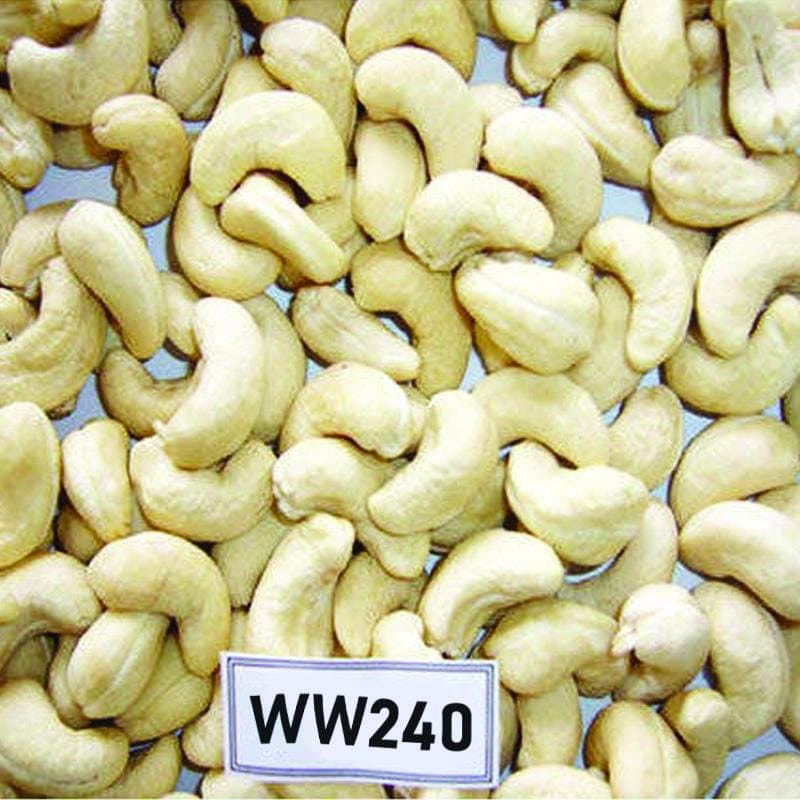
AFI counts as defects scorching, blemishes and discolouration, immature or shrivelled kernels, pitted spots, adhering testa (the thin reddish skin), knife scrapes larger than 5 mm, flux marks from sealing tins, and kernels of a lower quality class. Serious damage has its own, much smaller allowance and covers insects, mould, rancidity, decay and embedded shell.
| AFI quality class | Colour | Total defects, max | Serious damage, max |
|---|---|---|---|
| First quality (white, fancy) | white, light yellow or pale ivory | 8.0% | 1.0% |
| Second quality (scorched) | yellow, light brown, light ivory, light ash-grey, deep ivory | 11.0% | 2.0% |
| Third quality (special scorched) | deep yellow, brown, amber, light to deep blue | 14.0% | 2.0% |
Within serious damage, AFI caps insect damage at 0.5% and mould, rancidity, decay and impacted shell together at 0.5%.
If the cashews will be roasted, add AFI's roast test. Spots and scrapes that hide on a raw kernel show up after two to three minutes in oil at about 149°C, and AFI sets separate limits for the roasted result.
Foreign matter and food safety
AFI prohibits hair, glass, metal, stones and any other hard or sharp object, allows harmless extraneous matter such as paper or thread only below 0.01%, and permits no live insects. It also sets free fatty acids at most 1.5%, peroxide value at most 5 meq/kg and Salmonella negative in 375 g. Aflatoxin and pesticide residues follow the law of the country where the goods are sold, so write your own market's limits into the contract. Name the destination when you ask for a quote, and we will check those limits for your lot.
Packing
A kernel shipped at 4.5% moisture in a bag that loses its seal can arrive soft, so the packing line guards the moisture line. Our catalog offers four packs for cashew kernels:
| Pack | Net weight |
|---|---|
| Vacuum PE bag | 10 kg |
| Vacuum PE bag | 11.34 kg (25 lb) |
| Carton of 2 vacuum bags | 2 x 11.34 kg = 22.68 kg (50 lb) |
| Tin can | 10 kg |
AFI wants packing that is new, clean, dry and hermetically sealed, gas flushing with food-grade CO2 at a minimum of 60% and the balance nitrogen, cartons of at least 200-pound test (32 ECT), and lot or production codes on every carton that match the packing list. With those codes, one bad carton can be traced to its part of the lot.
Illustration
Standards on the price board
On our price board a whole grade carries a standard name after it: EU, ME, CN2 or Move hand, as in W320 (Move hand) or W240 (EU). The grade code gives the size, and the standard name stands for a quality and processing level. The same grade can appear under more than one standard, each with its own offer. Our guide to EU, ME, CN2 and Move hand explains what each standard covers. Copy grade and standard into the contract exactly as quoted, and approve a sample of that grade and standard before you sign. If you are not sure which standard suits your use, ask us.
Sample approval and inspection at loading
Colour and appearance are hard to pin down in writing. AFI recommends that two sealed pre-shipment samples go to the buyer for approval, one of them kept sealed in case a quality dispute goes to arbitration, and it accepts a delivery equal to or better than the approved sample.
AFI also says every shipment should be inspected before loading. Under FOB, risk passes to the buyer once the goods are on board the vessel, so an inspection at the port of loading is the buyer's last check before the risk changes hands. Write into the contract who inspects, who pays, and that the inspection certificate is one of the shipping documents.
AFI's sampling plan counts in 50-pound cartons, the size of the 22.68 kg carton above. A 13-tonne load of those cartons is about 573 cartons, and 13 of them are opened. A 26-tonne load is about 1,146 cartons, and 21 are opened. Each opened carton gives 275 to 500 g from at least three spots, with at least 3,500 g in total.
Check a sample yourself
AFI's analytical method splits one composite sample into portions for different tests. A kitchen scale and a tray are enough to follow it.
- Mix kernels from several bags or cartons into one composite sample of about 3.5 kg.
- Weigh 1,000 g, pick out every split, butt and piece, and weigh them. That is your broken percentage.
- Weigh 500 g of whole kernels, set aside those of the next smaller size, and weigh them for undersize.
- From another 500 g, sort out scorched, spotted, shrivelled and scraped kernels and those with adhering skin, and weigh them for defects. A kernel with two faults counts once, under the worse one.
- Count the whole kernels in 454 g and compare with the grade range.
- Look at colour in daylight or under full-spectrum light, then smell a handful from a freshly opened bag for rancidity.
Moisture needs a moisture balance or a lab. To see a lot before you commit, request a sample or ask for a quote on the grade and standard you need. All grades are on the cashew kernels page.
Frequently asked questions
What moisture should cashew kernels have?
AFI asks for 3% to 5%, measured as loss on drying at 105°C, and TCVN 4850:2010 sets a maximum of 5%. Our catalog sets 5% for whole grades and 4.7% for splits and pieces.
What is the difference between broken and undersize cashews?
Broken counts pieces, splits and butts in a whole grade, undersize counts whole kernels of the next smaller size. AFI allows up to 10% by weight for each, and TCVN 4850:2010 allows 5% for each.
Can I ask for tighter limits than AFI?
Yes. Our general limits follow AFI and can be negotiated for a custom order, for example a lower moisture maximum or less breakage. Write the agreed figure into the contract.
Who inspects cashews before loading on an FOB order?
AFI asks for inspection before loading on every shipment. Because FOB risk passes to the buyer when the goods are on board, a buyer can appoint an independent inspector at the port of loading.
Sources
- Association of Food Industries (AFI), Specifications for Cashew Kernels, updated September 2023, moisture and test method, tolerances, quality classes, defects, sampling plan, analytical methods, roast test, sealed samples
- TCVN 4850:2010, Specification for cashew kernels, bilingual Vietnamese and English text published by Vinacas, moisture, tolerances at packing, moisture method
- Export Council of Australia, "FOB, Free on Board (Named Place), Incoterms 2020", transfer of risk