Broken cashew grades: WS, LWP, SWP and BB explained
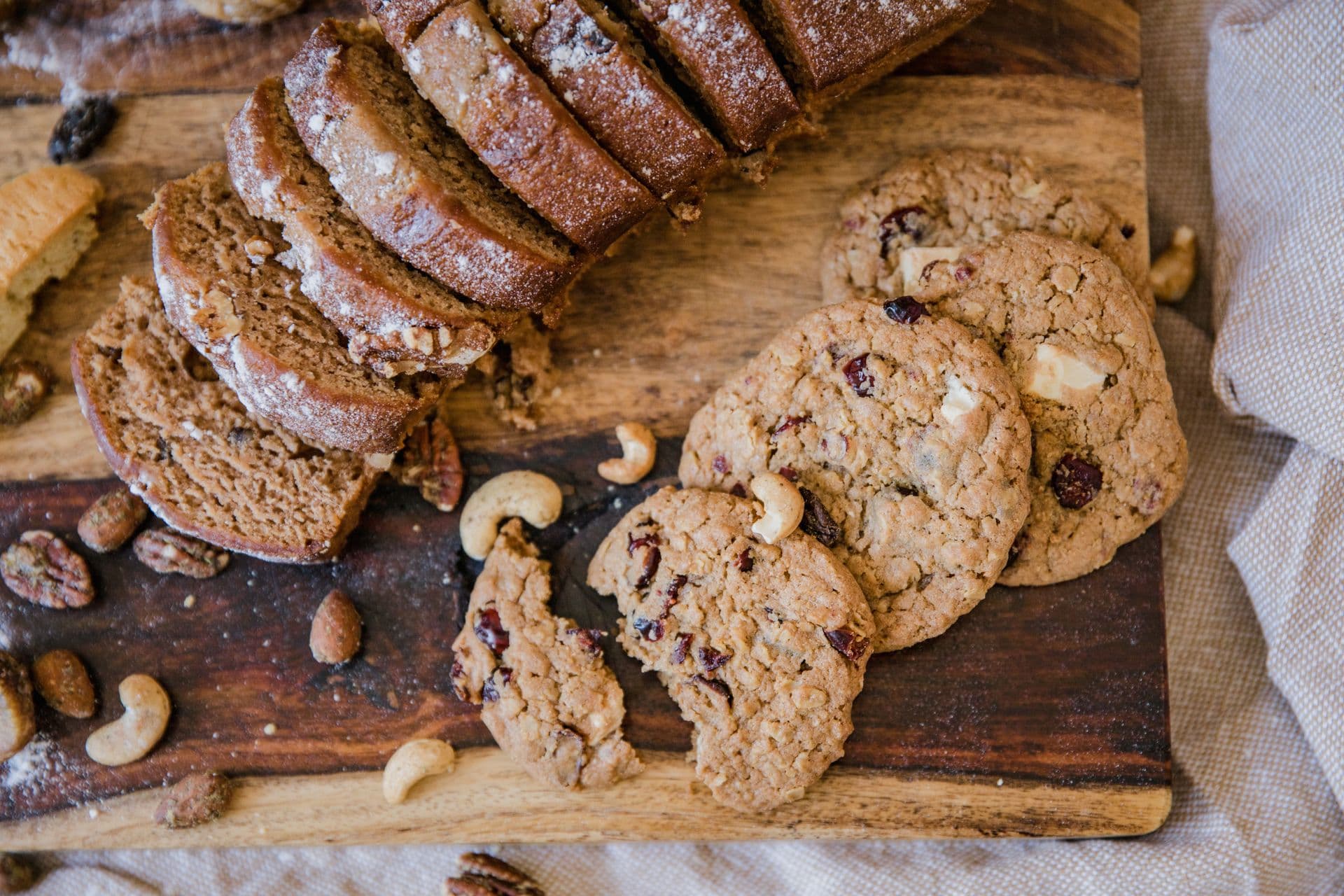
A bakery supplier orders "BB" cashews for a cookie topping. She expects crumbs about 2 mm across, the kind that scatter evenly over dough. The lot that arrives is small half-moons of kernel, each one a cashew snapped across the middle. The supplier shipped what its own sheet calls BB. Under the US Association of Food Industries (AFI) specification, BB means baby bits, fragments that pass a 2.36 mm sieve. Under Vietnam's national standard TCVN 4850:2010, BB means blemish butt. On our catalog, BB1 and BB2 are named Baby Butt, so the same two letters mean something different in each of the three documents.
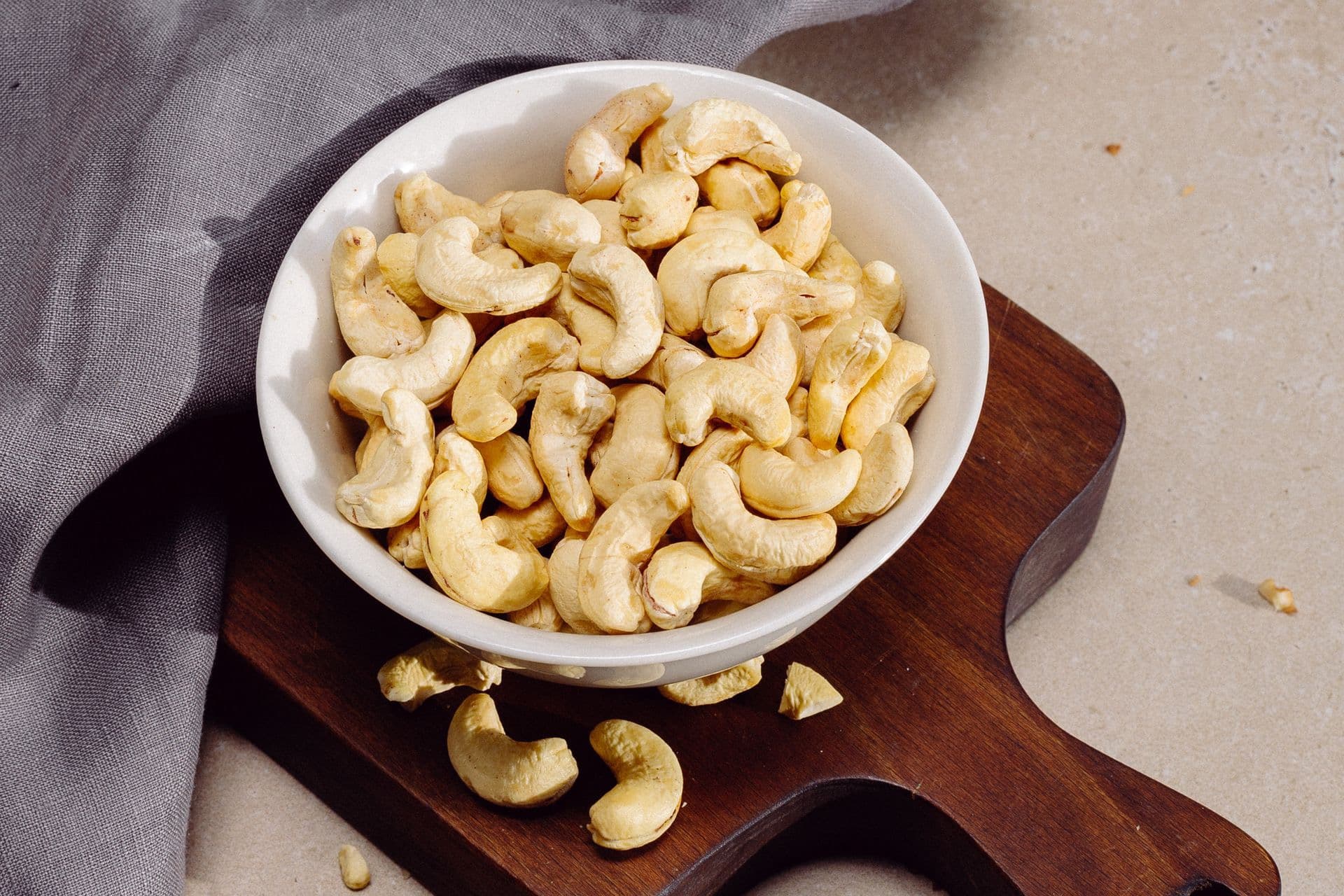
Broken cashew grades are kernels that came apart during processing, sorted by how they broke and how big the parts are. Splits (WS) are kernels split lengthwise into two halves. Butts are kernels broken across. Pieces (LWP, SWP) are smaller fragments sorted on sieves. They are the same nut as a whole W320, and they go where the kernel will be chopped, ground or baked into something anyway.
Where broken kernels come from
A raw cashew nut sits inside a hard shell full of caustic liquid, and getting the kernel out takes several rough steps. The nuts are heat treated, the shell is cut or cracked open, the kernel is dried, and the thin reddish skin (the testa) is peeled off. Then everything is graded. Any of those steps can break a kernel, and no processor gets every kernel out whole.
A 2018 trial of a centrifugal sheller in Nigeria found that nut moisture had a significant effect on how many kernels came out whole, and that size mattered a great deal: at the best settings, about 65% of large nuts came out whole against about 38% of small ones. A 2014 study in India compared peeling machines and found the best one recovered about 70% of kernels whole, with a second pass through the machine lowering that further. These are figures from trials and prototypes and say nothing about an industry average. They do show why a factory that packs whole kernels also packs splits, butts and pieces from the same nuts.
Splits, butts and pieces: three ways to break
AFI and TCVN 4850:2010 define the shapes in nearly the same words.
- A split is one half of a kernel split lengthwise, with no more than 1/8 of that half broken off.
- A butt is a kernel broken crosswise, between 3/8 and 7/8 of a whole kernel, with the two halves (the cotyledons) still naturally attached.
- A piece is anything smaller, and pieces are graded by sieve size.
The W at the start of WS, LWP and SWP means white, the same colour class as white whole kernels. TCVN gives scorched splits and pieces their own codes (SS, LSP, SSP), so a W in the code tells you which colour you are buying.
The broken grades on our catalog
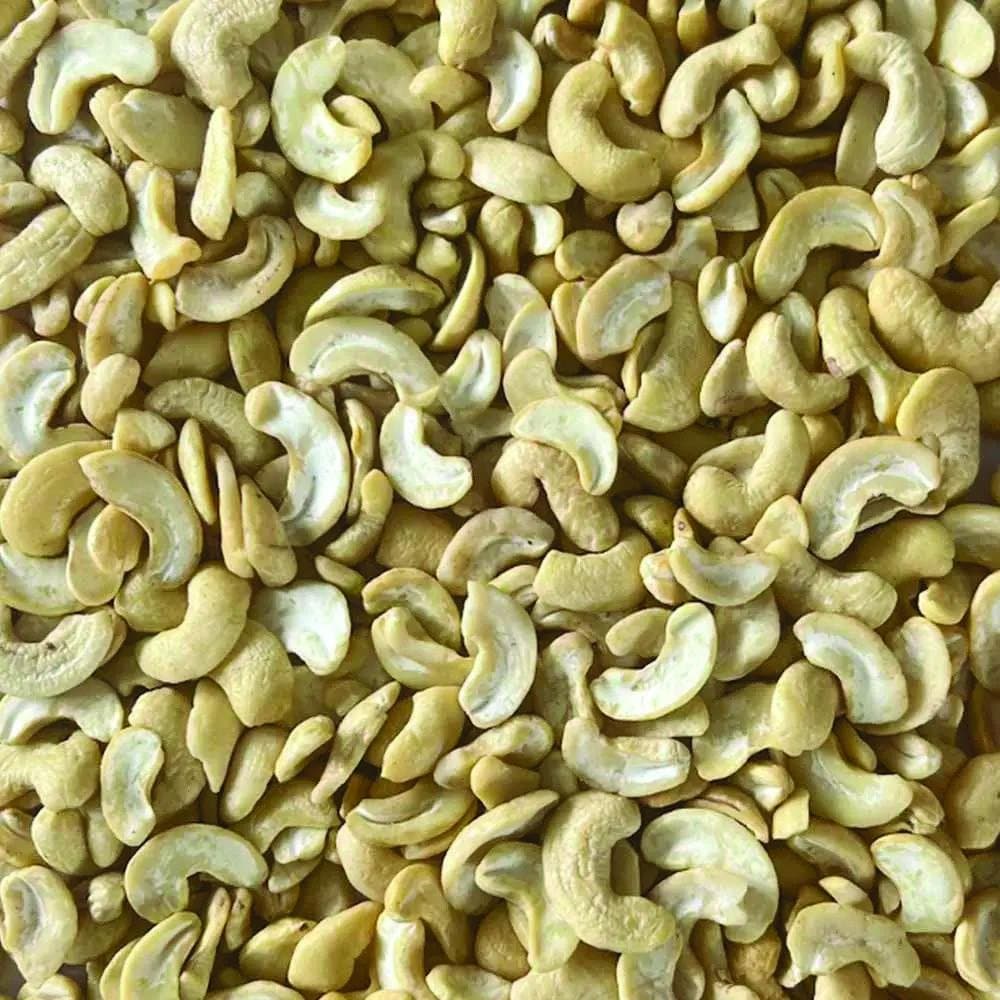
Our catalog lists seven broken grades in two groups, splits and pieces. Each carries a moisture limit of 4.7%, tighter than the 5% maximum that both AFI and TCVN allow for cashew kernels in general.
| Code | Catalog name | Group | What the code describes | Moisture, max |
|---|---|---|---|---|
| WS180 | Broken Cashew Kernels WS180 | Splits | White splits, named after the 180 size class | 4.7% |
| WS Mix | Broken Cashew Kernels WS Mix | Splits | White splits of mixed sizes | 4.7% |
| LWP | Large White Pieces (LWP) | Pieces | White kernels broken into large pieces | 4.7% |
| SWP1 | Small White Pieces (SWP1) | Pieces | White kernels broken into small pieces | 4.7% |
| SWP2 | Small White Pieces (SWP2) | Pieces | White kernels broken into small pieces | 4.7% |
| BB1 | Baby Butt (BB1) | Pieces | Small butts, kernels broken crosswise | 4.7% |
| BB2 | Baby Butt (BB2) | Pieces | Small butts, kernels broken crosswise | 4.7% |
The 1 and 2 after SWP and BB mark sub-grades on the processor's sheet. AFI and TCVN 4850:2010 size small pieces with the sieves in the next section, and where one sub-grade ends and the next begins can be agreed for your order. Tell us the sieve range you work to when you ask for a quote and we will confirm it for your lot. Ask for a photo of each sub-grade too, and compare samples side by side before you sign. The full range, whole grades included, is on the cashew kernels page.
Sieve sizes: where AFI and TCVN part ways
Pieces are sized with sieves, and the two standards a Vietnamese lot is most often measured against set the sieves differently. AFI asks for ISO woven wire mesh with square openings and says round-hole sieves are not equivalent.
| Size class | AFI: passes through | AFI: 95% retained on | TCVN 4850:2010 |
|---|---|---|---|
| Large pieces (LP, LWP) | 8.00 mm | 6.30 mm | passes 8 mm, retained on 4.75 mm |
| Small pieces (SP, SWP) | 6.30 mm | 2.80 mm | passes 4.75 mm, retained on 2.8 mm |
| Chips | 2.80 mm | 2.36 mm | no separate class |
| Baby bits (BB in AFI, B-B in TCVN) | 2.36 mm | 1.70 mm | does not pass 1.7 mm |
Take a fragment that falls through a 6.30 mm opening but stays on 4.75 mm. AFI calls it a small piece. TCVN calls it a large piece. A buyer who writes "LWP" into a contract and measures on AFI sieves can find a good share of the lot below grade, while the seller, measuring on TCVN sieves, finds the same lot in grade.
AFI also sets tolerances. No more than 5% by weight of a piece grade may pass through the sieve it should stay on, and no more than 10% by weight of a butts or splits grade may be pieces.
Which broken grade for which job
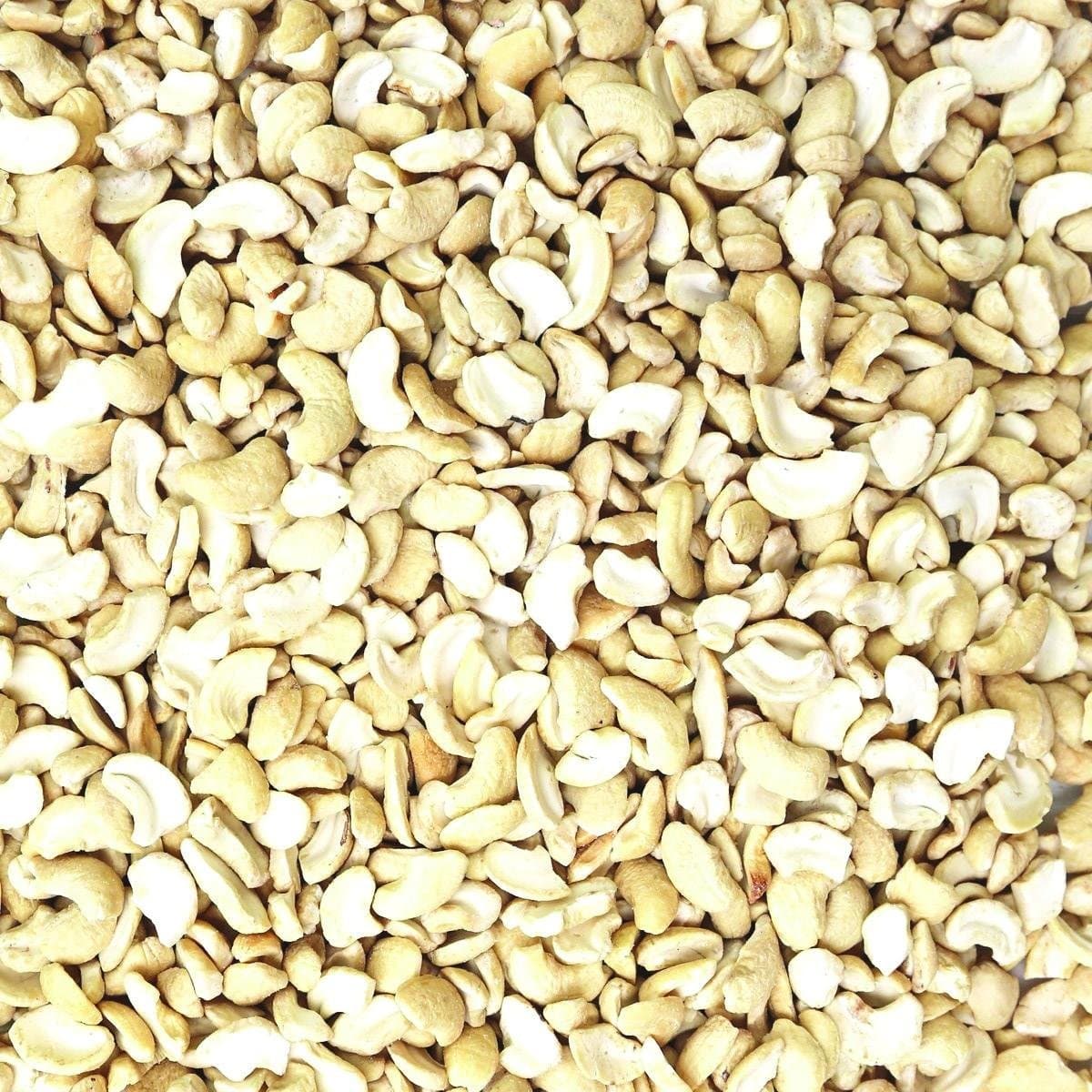
Trade sources put broken cashews into nut butters, confectionery, bakery and general food processing, the places where nobody sees a whole kernel.
| Grade | Typical uses | What to watch |
|---|---|---|
| WS (splits) | Snack mixes, bakery where the half-kernel shape should still show | Share of pieces mixed in with the halves |
| LWP | Granola and protein bars, bakery | Evenness of size, since a large fragment can stand out in a thin bar |
| SWP | Spreads, sauces, flavoured coatings, bakery | Dust and fines at the bottom of the bag |
| BB (baby butts, our catalog) | General food processing | Confirm in writing that butts, not bits, are meant |
| Baby bits (AFI BB) | Pastes, cashew butter, industrial uses | Colour, because fine fragments show discolouration in a paste |
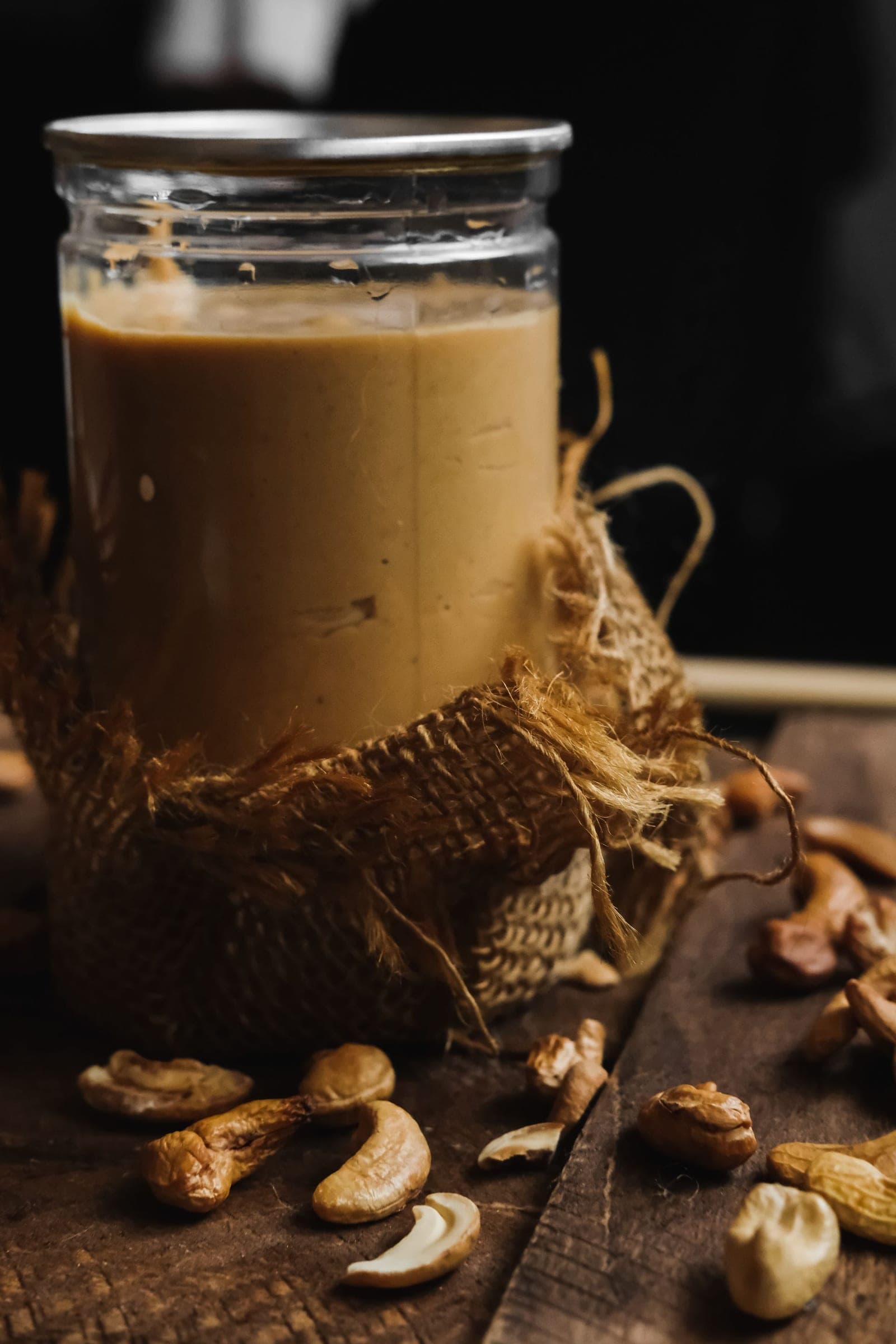
If the cashew will be ground, as in cashew butter or a sauce base, size does no work at all and you are paying only for flavour, colour and cleanliness. If the cashew sits on top of a cookie or in a clear-window bar, buyers see it, and an even size from LWP or SWP is what makes the product look finished.
Illustration
Check a lot yourself with three sieves
The AFI method for sizing pieces is short enough to do in a warehouse or on a lab bench.
- Draw a composite sample. Take kernels from several cartons and from different depths in each, then mix. AFI's sampling plan asks for at least 3,500 g in total for a lot, drawn from 3 or more spots in each carton.
- Weigh out 200 g of the mix.
- Stack square-mesh sieves with the largest opening on top and a pan underneath. For LWP on AFI terms, use 8.00 mm and 6.30 mm. For SWP, use 6.30 mm and 2.80 mm. If your contract follows TCVN, use 8, 4.75 and 2.8 mm instead.
- Shake for 2 minutes. AFI uses a mechanical shaker. By hand, keep the motion steady and time it.
- Weigh what sits on each sieve and in the pan. Under AFI, no more than 5% of the weight should have fallen through the bottom sieve of the grade.
For splits, skip the sieves. Spread 200 g on a dark tray and pick out anything that is not a clean half: butts, pieces, whole kernels. Weigh the pick-outs. Under AFI, pieces should stay at or below 10%.
Two more checks take a few minutes. Look at colour in daylight or under full-spectrum light, as AFI asks. Then smell a handful from a freshly opened bag, since off odours and rancidity are what AFI's sensory check is for.
What to put in the contract
The cookie topping order at the top of this guide went wrong over two letters. These lines settle what a broken grade means before the goods ship:
- the grade code and the standard it follows, for example "LWP as defined in TCVN 4850:2010" or "large white pieces per AFI"
- the sieve openings in millimetres, with square wire mesh named
- the tolerance by weight for material passing the lower sieve, and for pieces in a splits grade
- the colour class (white, or scorched if that is what you want)
- the moisture maximum, which is 4.7% for the broken grades on our catalog
- two sealed pre-shipment samples, one of which stays sealed in case of a dispute, as AFI recommends
For the whole grades and how their count works, see the guide to cashew kernel grades. To see the broken grades before you commit, request a sample or ask for a quote. The current FOB offers for each grade are on our price board, since prices change every week.
Frequently asked questions
What does WS mean in cashew grades?
White splits: white cashew kernels split lengthwise into their two natural halves, each half with no more than 1/8 broken off. On our catalog, WS180 and WS Mix are both splits grades.
Is BB baby bits or baby butts?
It depends on the document. AFI uses BB for baby bits, fragments that pass a 2.36 mm sieve and stay on 1.70 mm. TCVN 4850:2010 uses BB for blemish butt and B-B for baby bits. Our catalog names BB1 and BB2 Baby Butt. Write the meaning and the size into the contract.
Are broken cashews lower quality than whole cashews?
Breakage describes shape. Colour, moisture, insect damage and other defects are judged on their own scales, and a white piece can be as clean and fresh as a white whole kernel. The lower price of broken grades pays for the lost shape.
Which broken cashew grade is best for cashew butter?
Any clean white grade works, because grinding removes size. A small-piece grade that meets your colour and flavour standard does the job. Check colour closely, since discoloured fragments darken a paste.
Sources
- Association of Food Industries (AFI), Specifications for Cashew Kernels, updated September 2023, definitions of whole, butts and splits, Table 2 sieve sizes for pieces, tolerances, sampling plan, colour and sensory checks, sealed pre-shipment samples
- TCVN 4850:2010, Specification for cashew kernels, bilingual Vietnamese and English text published by Vinacas, definitions, abbreviations (BB, B-B) and sieve sizes for large and small pieces and baby bits
- Kilanko, O. et al., "Design and performance evaluation of centrifugal cashew nut sheller for improving the whole kernel recovery", Agricultural Engineering International: CIGR Journal 20(1), 2018, 162-170
- Balasubramanian, D., "Comparative performance of mechanised peeling machines for unpeeled cashew kernels: a case study", Journal of Plantation Crops 42(3), 2014, 323-328
- Nutrada, "Cashew grades in detail", uses of broken grades